Luxury Safaris in Namibia for Couples
Namibia suits couples for two specific reasons: emptiness and darkness. NamibRand was certified Africa’s first International Dark Sky Reserve in 2012, and several lodges — Little Kulala, Doro Nawas, Sossusvlei Desert Lodge — are built around sleeping under it., the dry winter. Rainfall is near zero, wildlife concentrates at Etosha’s waterholes, and roads are at their best. July and August are the peak — and the coldest, near 6 °C at dawn.
Most couples-safari copy is interchangeable: candlelit dinners, rose petals, a private plunge pool. Namibia can do all of that, but none of it is why the country works for two people. What it actually has is more space than almost anywhere on earth and a night sky with a formal certification to prove it — and a handful of properties designed around the second of those.
The sky is the argument
In 2012 the International Dark-Sky Association designated the NamibRand Nature Reserve an International Dark Sky Reserve. It was the first in Africa and, according to the reporting at the time, the first anywhere in the developing world. NamibRand itself is a private reserve of more than 215,000 hectares, founded in 1984 by J.A. Brückner and funded through tourism revenue rather than donations.
That certification is worth more than any lodge’s marketing claim, because it was awarded by an outside body against published criteria. It is also why the sleeping-outside idea is not a gimmick here — several Namibian properties have built specifically for it, and under this sky a bed on a roof is a genuinely different experience from a bed indoors.
What actually makes a trip work for two
Three practical things matter more than any amenity list. First, timing: aim for the dry winter, roughly May to October, and then pick the week around new moon rather than full — it is the single decision that most changes what you will see at night, and it costs nothing.
Second, pace. Namibia’s distances are genuinely long and the driving is a real part of the trip rather than dead time between lodges. Two nights minimum in each place is the difference between a holiday and a logistics exercise. Three or four properties in two weeks is comfortable; six is not.
Third, be honest about the coast. Swakopmund and Walvis Bay are worth two nights for the dunes, the lagoon and the food, but the sea here runs roughly 13°C to 19°C and nobody is swimming in it. Couples who want beach time at the end almost always add Zanzibar or Mozambique rather than trying to find it in Namibia.
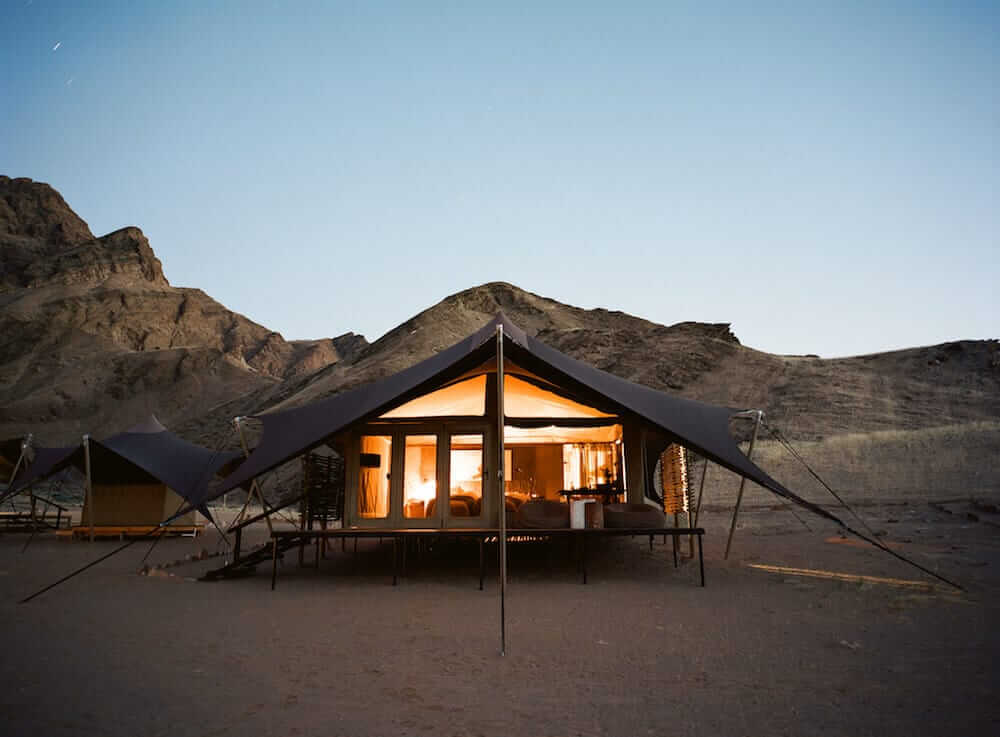
Almost every property listed above describes its own star beds and skylights on its own website, which is not the same as an independent source. Ask whether the star bed is on every unit or only some, and what happens if the wind gets up — most have a plan, but it varies, and it is the sort of detail that decides whether the thing you booked for actually happens.
Where this fits in a route
The properties that do this well are clustered — the NamibRand and Sossusvlei area first, then Damaraland and the Kunene if you want the far north-west. That is a natural two-week shape and it does not need to be rushed. A nineteen-day luxury route has enough room to add Etosha without cutting the desert nights. For more routes like this, see our Namibia luxury safaris.
If the night sky is the reason you are coming, our guide to stargazing in Namibia covers what you can actually see from this latitude and which claims about NamibRand hold up. For the properties themselves rather than the romance framing, the lodge round-up is the better starting point.
Frequently asked questions
What makes Namibia different for a couples trip?
Space and darkness rather than romance packaging. Namibia has the emptiest landscapes in southern Africa and, at NamibRand, Africa’s first certified International Dark Sky Reserve. Several lodges are built around sleeping outside under it.
Which Namibian lodges have star beds?
Little Kulala at Sossusvlei publishes a private rooftop star bed on each of its 11 chalets, which rolls under cover in bad weather. Doro Nawas in Damaraland wheels a star bed onto the private veranda. Sossusvlei Desert Lodge has a skylight over the bed in each of its 10 suites.
Is NamibRand really the darkest sky in Africa?
It is the first certified one. The International Dark-Sky Association designated NamibRand an International Dark Sky Reserve in 2012 — the first in Africa and, per the reporting at the time, the first in any developing nation.
When is the best time for a couples trip to Namibia?
The dry winter, roughly May to October, gives clear nights and comfortable days. For stargazing specifically, aim for the week around new moon — a full moon washes out everything but the brightest objects.
Do you need to fly between lodges?
No, but it changes the trip. Namibia’s distances are long and the driving is a large part of the experience. Flying removes that, at the cost of the landscape between places. Many couples do a mix.
Is a Namibian honeymoon a beach trip?
No. The coast is cold — sea temperatures at Swakopmund run roughly 13°C to 19°C. Namibia is a desert-and-sky destination; couples wanting beach time usually add Zanzibar or Mozambique afterwards.
Desert Tracks builds Namibian journeys for two without the honeymoon package framing. Tell us what you both actually want and we will shape the route. Tell us what you want out of the trip rather than when you can travel, and we will tell you honestly whether your dates fit — including when the answer is that they do not. Get in touch with Desert Tracks.