Namib Desert Animals – The Specialists, and Four Stories Your Guide Has Wrong
The Namib’s animals are specialists: beetles that harvest fog by head-standing, lizards that dive into sand, an adder that sidewinds and buries itself with only its eyes exposed, and a golden mole that hunts by listening to wind through its skull. Several of the famous explanations are wrong., the dry winter. Rainfall is near zero, wildlife concentrates at Etosha’s waterholes, and roads are at their best. July and August are the peak — and the coldest, near 6 °C at dawn.
The Namib is the oldest desert on earth and almost everything living in it is doing something unusual to stay there. That makes it superb material for guides, and it has also made it superb material for stories that got repeated until they hardened into fact. Four of the best-known ones have been tested by researchers and did not survive. The real mechanisms are, in every case, more interesting than the versions that replaced them.
The fog-basking beetle, and the myth built on it
On fog mornings, a darkling beetle called *Onymacris unguicularis* climbs the slipface of a dune, turns to face the incoming fog, and stands on its head — tilting its body about 23 degrees so that condensation runs down its wing cases into its mouth. It takes about two minutes to settle into the stance. Over a couple of hours it collects around 0.16 ml of water, and can take in water equal to about a third of its body mass. Only two species are known to do it: *O. unguicularis* and *O. bicolor*.
Now the correction. You will be told that the beetle’s shell is covered in bumps whose tips are water-attracting while the troughs between them are waxy and water-repelling, so fog condenses on the peaks and rolls off. That claim, published in 2001, launched an entire biomimetic-materials industry. It was tested in 2010 and it failed: every beetle examined had wing cases that were completely hydrophobic, with no hydrophilic areas anywhere. And the direction of the effect is not what the story requires: measured per unit area, the bumpiest species tested collected the most water and another bumpy species collected the least, so bump structure does not predict collection either way. The beetle in the original paper — re-identified as Physasterna cribripes rather than Stenocara — does not fog-bask at all. Fog harvesting in the Namib is behavioural, not structural.
The shovel-snouted lizard’s dance
The thermal dance of *Meroles anchietae* is real. Cool in the early morning, it emerges and presses its belly flat against the sand to warm up. As the surface heats it straightens its legs to lift its body clear, then begins raising diagonally opposite limbs in rotation while resting on the base of its tail — two feet up, two down, alternating. When the sand becomes too hot to stand on at all, it stops dancing and dives in. Precise threshold temperatures for this are quoted confidently all over the internet; we could not trace them to a source we could read, so we are describing the behaviour rather than putting numbers on it.
The sand-diving is not only thermal. It is also how the lizard escapes predators, and after fog events these lizards rehydrate by drinking fog water from wet sand and vegetation.
Peringuey’s adder
A small sidewinding viper, averaging about 25 cm, with its eyes set on top of its head rather than the sides — so it can bury itself in sand and still watch what is coming. Sidewinding is what makes loose dune sand negotiable, and it also minimises contact with hot surfaces by alternating which parts of the body touch the ground. It specialises in lizards, particularly *Meroles* sand lizards and barking geckos.
Two honest notes. Its venom is mildly cytotoxic, causing pain and swelling, and is not considered dangerous to humans — antivenom is neither required nor effective. And the tail-luring behaviour often attributed to it is well documented in the puff adder but we could not find a source confirming it for Peringuey’s specifically, so we are not claiming it. We looked for a source confirming fog-basking in this species as well, and could not find one we could read — so that is another claim we are leaving out rather than repeating.
The spider that does not cartwheel
Almost every guide in Namibia will tell you the dancing white lady spider escapes wasps by curling into a ball and cartwheeling down the dune face. It is a wonderful piece of natural history and it belongs to a different animal.
The wheeling escape is the golden wheel spider, *Carparachne aureoflava*. The dancing white lady, *Leucorchestris arenicola*, lives in the same dunes and does something else entirely: it digs a burrow angled at 19 to 29 degrees, averaging about 22 cm deep and ranging from 9 to 67 cm, and lines the walls with rows of spun sand nodules. Males then make nocturnal excursions of tens to hundreds of metres and return in a nearly straight line to a burrow they cannot see — one of the most impressive feats of path integration recorded in any arthropod. Researchers tested whether they were using the dune slope to navigate and concluded they were not. Nobody knows how they do it.
The oryx and the brain-cooling story
The version you will hear: the gemsbok’s carotid rete cools blood before it reaches the brain, which lets the animal safely allow its body temperature to climb to 45°C and so save water. It is a great story and the causation in it has been reversed by later work.
The brain turned out not to be as vulnerable as assumed — goats tolerated brain temperatures of 42.5°C for an hour with no apparent ill effect. What selective brain cooling actually does is modulate water use: cooling the hypothalamus suppresses the neural drive to pant and sweat. A one-degree reduction in hypothalamic temperature produced roughly a six-fold decrease in respiratory water loss in goats, and sheep using the mechanism for half a day save about 2.4 litres — some 60% of their daily water requirement.
In gemsbok specifically, selective brain cooling begins at 39.5°C and its magnitude is 0.9°C. Real, useful, and nothing like the dramatic figures in circulation. We are also not repeating the 45°C body-temperature claim, because the studies challenging it were behind paywalls we could not open — and an unverified number is worth less than an honest gap.
The !nara, which holds the whole system together
The !nara melon is a leafless, spiny, dioecious cucurbit that photosynthesises through its stems and builds sandy hummocks over five metres high and a thousand square metres in area. It is described in the literature as a keystone endemic of the Namib. Its roots reach groundwater, making it a semi-obligate phreatophyte, and its melons are concentrated water and carbohydrate for gemsbok, springbok and jackals.
It also sustains people. Around 350 Topnaar live along the lower Kuiseb partly on the !nara harvest, pressing the seeds for oil. Jackals disperse the seeds — lacking chewing molars, they pass them intact in nutrient-rich dung. The main threat is free-ranging donkeys, which strip dozens of melons and flowers in a single visit and hit hardest during drought.
Seeing any of this
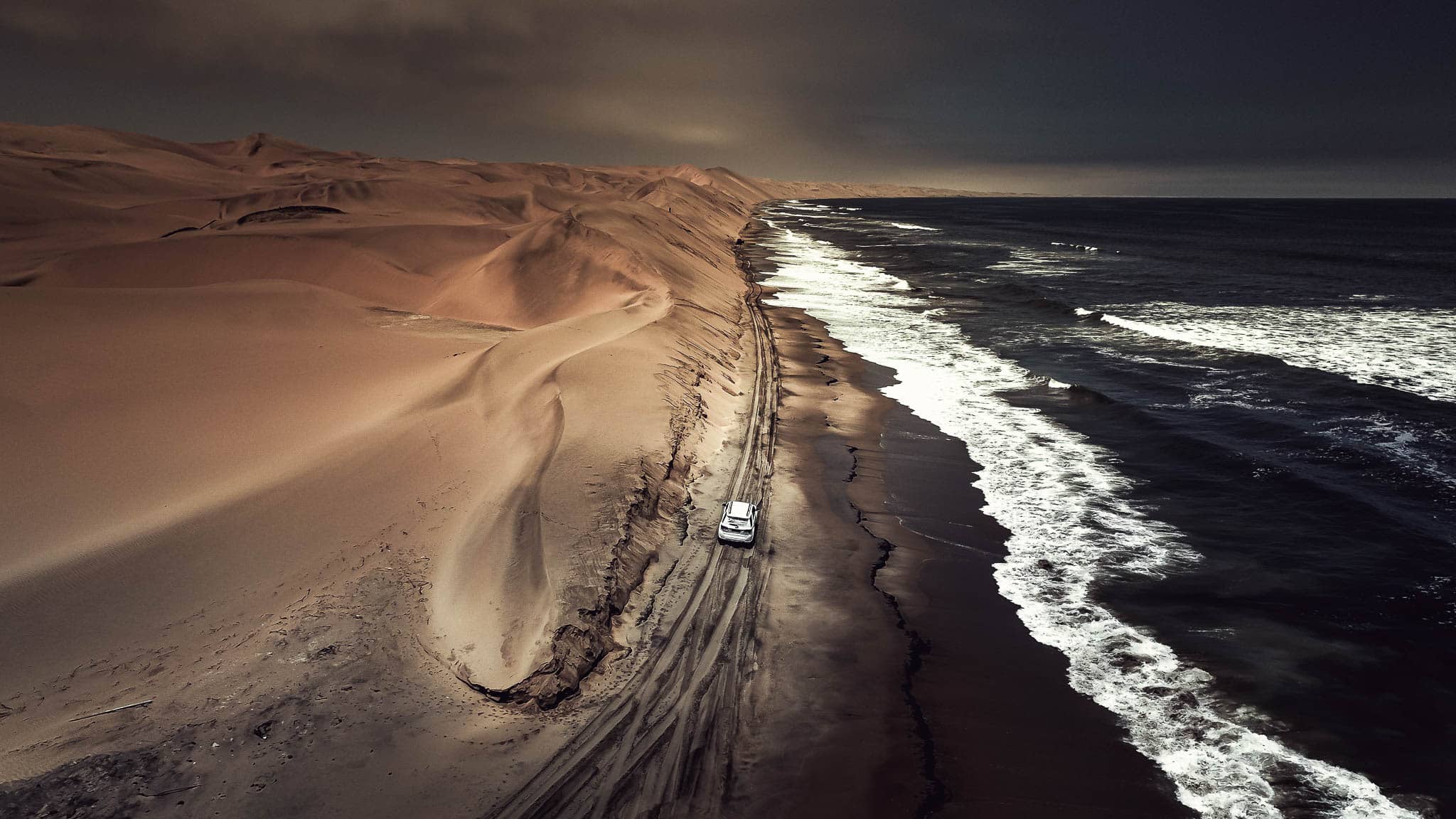
A living-desert tour from Swakopmund is the honest answer. These are small animals in a large place, and a guide who knows which hummock to check and how to read a track will show you in three hours what you would not find in three days alone. Ask for the tracks of the golden mole, which is the one nobody ever sees, and the jackal scat full of !nara seeds — that is the whole food web in one place.
The sources behind the corrections above are worth reading directly if this interests you: the 2010 study that tested the beetle-shell claim and the review that reframed selective brain cooling. For a route built around the desert rather than the big animals, that is what our self-drive itineraries are for.
Frequently asked questions
How do Namib desert beetles collect water from fog?
By standing on their heads. Onymacris unguicularis climbs to the top of a dune slipface on fog mornings, faces into the wind and tilts its body about 23 degrees so fog condenses on its wing cases and runs down to its mouth. It gains up to 34% of its body water this way. The popular explanation involving bumps on the shell has been tested and does not hold.
What animals live in the Namib Desert?
Specialists rather than generalists: fog-basking darkling beetles, the shovel-snouted lizard that dives into sand, the web-footed gecko, Peringuey’s adder which sidewinds and buries itself with only its eyes showing, the Namaqua chameleon, dune spiders, oryx, springbok and desert-adapted elephant and lion in the north-west.
Do oryx really let their body temperature rise to survive the heat?
That story has been superseded. The carotid rete does cool blood going to the brain, but current research shows the function is water conservation, not brain protection — cooling the hypothalamus suppresses the drive to pant and sweat. The measured cooling in gemsbok is about 0.9°C, far less dramatic than usually described.
Desert Tracks arranges self-drive and fly-in itineraries across Namibia, Botswana and East Africa. A living-desert morning out of Swakopmund is the cheapest good decision on any Namibian route. Tell us what you want out of the trip rather than when you can travel, and we will tell you honestly whether your dates fit — including when the answer is that they do not. Get in touch with Desert Tracks.