Namibia Religion – Faith, Missionaries and What the Census Never Asked
Namibia is overwhelmingly Christian and predominantly Lutheran. Estimates put Christians between 90.5% and 97% of the population, with roughly half Lutheran and a fifth Catholic. No Namibian census has ever asked about religion, so every figure in circulation is an estimate., the dry winter. Rainfall is near zero, wildlife concentrates at Etosha’s waterholes, and roads are at their best. July and August are the peak — and the coldest, near 6 °C at dawn.
Almost every article about religion in Namibia opens with the same line: 97% Christian, 50% Lutheran. It is repeated so often that it reads like census data. It is not. Namibia’s census has never asked anyone about their religion, and that widely-quoted figure traces back to a single survey estimate from 2015. The more recent numbers tell a slightly different story, and the reason Namibia is Lutheran at all is one of the more interesting things about the country.
What the numbers actually say
We checked the 2023 Population and Housing Census directly. It covers population structure, marital status, citizenship, ethnicity, disability, education and housing. Religion is absent from it entirely. So the honest position is that nobody has counted.
The 97% line comes from a 2015 estimate. Pew’s own more recent work puts Namibia’s Christian share at 90.5% in 2020, down from 96.1% in 2010 — and names Namibia as one of the countries where that share fell over the decade. Both numbers get quoted as current. Only one of them is.
Membership counts are firmer than percentages, because churches keep their own registers. The Lutheran World Federation records 853,522 members in the Evangelical Lutheran Church in Namibia and 420,000 in the Evangelical Lutheran Church in the Republic of Namibia for 2023 — about 1.28 million Lutherans between them. The Catholic Church recorded 495,000 Catholics in 104 parishes as at 31 December 2023.
Why Lutheran, and not Catholic or Anglican
The answer is simply which missionaries got where, and when. Two entirely separate Lutheran missions worked in what is now Namibia. The German Rhenish Missionary Society began in the centre and south in 1842. The Finnish Evangelical Lutheran Mission began among the Ovambo and Kavango peoples of the north in 1870. They were not connected to each other.
The north is Namibia’s population heartland, which is why the Finnish-founded church became the largest in the country. The Finnish missionaries are also remembered rather differently from the German ones — for keeping their distance from the German, British and South African colonial administrations they worked alongside.
Traditional belief, and why it is hard to count
Estimates of indigenous belief range from about 3% to nearly 6% of the population depending on the source, and the gap is not a measurement error — it is a definitional one. For many Namibians traditional practice sits alongside Christianity rather than instead of it, which makes it nearly impossible to record as a separate box on a form. Some Zionist churches combine the two explicitly. Namibia’s school curriculum includes a non-sectarian religious and moral education strand covering African traditions alongside world religions.
The minority faiths are small but present. Muslims, Baháʼís, Jews, Buddhists and non-believers together make up roughly 3% of the population. The Baháʼí community is proportionally larger than the Muslim one. Namibia has one synagogue, built in Windhoek in 1924, serving a community of around a hundred people with no permanent rabbi.
What this means if you are visiting
- Namibia is constitutionally secular. Article 1(1) of the Constitution establishes it as a secular state, and Article 21(1)(c) protects the freedom to practise and manifest any religion.
- Four of the eleven public holidays are Christian — Good Friday, Easter Monday, Ascension Day and Christmas Day. Plan travel days around them.
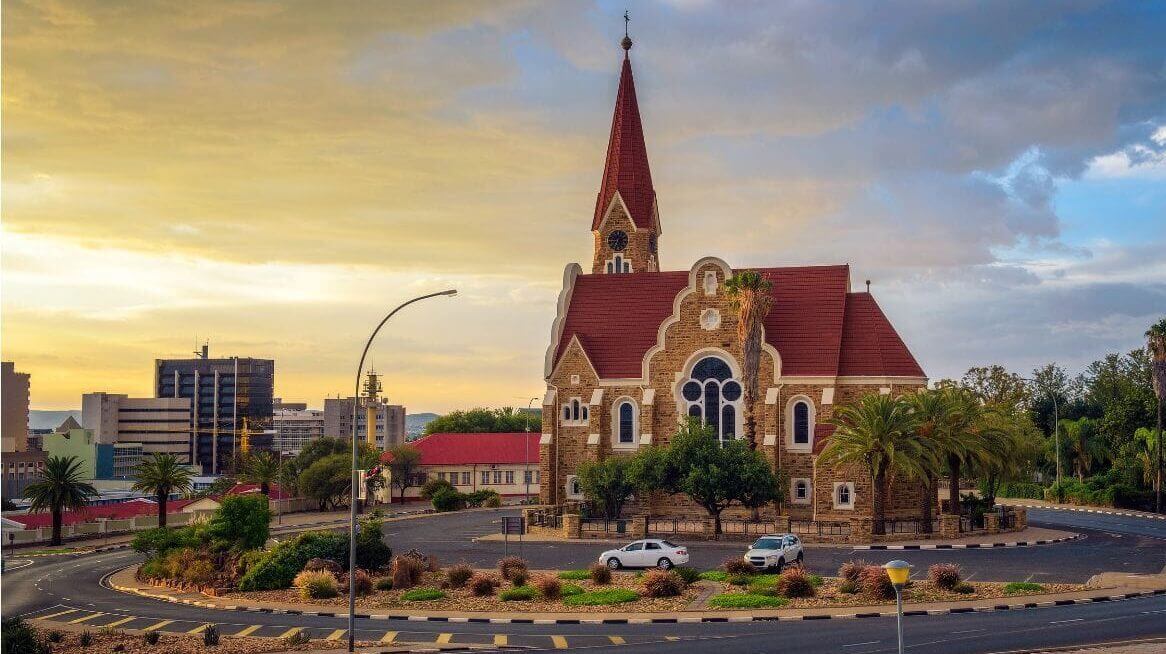
- The churches are part of the architecture. Windhoek’s Christuskirche, consecrated on 16 October 1910 and a national monument since 1974, is the most photographed building in the country.
- One practical caution. The Christuskirche stands directly in front of the government buildings, and Namibian police have detained people for photographing official buildings. Point the camera at the church, not past it.
The honest gaps
There are things about religion in Namibia that simply are not documented, and we would rather say so than fill the space. There is no published figure for Anglican membership in Namibia — Anglicans sit inside an undifferentiated “other denominations” bucket in every source we could find. There is no survey of church attendance. And there is no authoritative guidance on visiting services as a tourist, dress expectations or photography inside churches, which means the confident advice you will read elsewhere on those points is somebody’s guess.
If the cultural side of Namibia is what interests you, the peoples of Namibia covers who lives where, and the festival calendar covers what is worth timing a trip around. We also run guided itineraries where a Namibian guide can answer this properly rather than in a blog post.
Frequently asked questions
What religion is most practised in Namibia?
Christianity, by a wide margin, and Lutheranism within it. The 2023 US State Department religious freedom report cites a 2015 Pew estimate of roughly 97% Christian, about 50% Lutheran and 20% Catholic. Pew’s own 2020 figures put the Christian share lower, at 90.5%.
Why are so many Namibians Lutheran rather than Catholic?
Because of which missionaries arrived where. The German Rhenish Missionary Society began work in the centre and south in 1842, and the Finnish Evangelical Lutheran Mission began among the Ovambo and Kavango in 1870. The north is Namibia’s population heartland, which is why the Finnish-founded ELCIN is the country’s largest church with 853,522 members.
Is Namibia a secular country?
Yes, explicitly. Article 1(1) of the Namibian Constitution establishes Namibia as a sovereign, secular, democratic and unitary State, and Article 21(1)(c) guarantees the freedom to practise any religion and to manifest that practice.
Desert Tracks arranges self-drive and fly-in itineraries across Namibia, Botswana and East Africa. If the country’s history and culture are what draw you, tell us and we will build the route around them. Tell us what you want out of the trip rather than when you can travel, and we will tell you honestly whether your dates fit — including when the answer is that they do not. Get in touch with Desert Tracks.