Stargazing in Namibia: Where the Skies Are Darkest
The NamibRand Nature Reserve was certified an International Dark Sky Reserve by DarkSky International in 2012 and is the darkest accessible sky in Namibia. The Milky Way’s core is best placed from June to August, and you want the week around new moon., the dry winter. Rainfall is near zero, wildlife concentrates at Etosha’s waterholes, and roads are at their best. July and August are the peak — and the coldest, near 6 °C at dawn.
Namibia has three things that make a night sky exceptional and almost nowhere has all three: no cloud, no moisture, and no people. Add a southern latitude that puts the centre of our own galaxy directly overhead in winter, and you get a sky that regularly reduces first-time visitors to silence. What follows separates what is certified from what is claimed.
NamibRand, and what is actually certified
DarkSky International — until recently the International Dark-Sky Association — certified the NamibRand Nature Reserve as an International Dark Sky Reserve in 2012. That much is on the certifying body’s own listing and is not in dispute.
Two of the claims commonly attached to it hold up under checking, and a third does not. The reserve’s own site describes it as a Gold Tier reserve and as the first International Dark Sky Reserve in Africa and in the developing world. DarkSky International’s current page for the site says neither of those things — it makes no tier claim and no first-in-Africa claim. But both are independently reported in contemporary science-press coverage of the 2012 certification, so they do not rest on the reserve alone. The claim that does not hold is the one calling NamibRand the only Dark Sky Reserve in Africa: DarkSky now lists other certified dark sky places on the continent, including a sanctuary in the South African Kalahari and a park in Limpopo. First is defensible; only is not.
Even the reserve’s size is unsettled: DarkSky lists 2,022 km², while other sources give more than 215,000 hectares, over 203,000 hectares, and more than 200,000 hectares. That is a spread of roughly 2,020 to 2,150 square kilometres depending on who is counting.
You will see NamibRand described as Bortle Class 1, and elsewhere as Class 2, sometimes with sky-quality readings of 21.9 to 22.0 magnitudes per square arcsecond attached. Neither claim comes from a named measurer, an instrument or a date, and no Bortle number appears on DarkSky’s own page. It is a genuinely dark sky. The specific class number is not established.
What the southern sky gives you
For anyone travelling from the northern hemisphere, the appeal is not simply darkness — it is a different half of the sky. The Large and Small Magellanic Clouds, two satellite galaxies of the Milky Way, are visible to the naked eye. So is the Southern Cross, sitting low and pointing toward the south celestial pole. Omega Centauri, the largest globular cluster in the galaxy, appears as a faint naked-eye smudge and resolves into thousands of stars through even a modest telescope.
The centrepiece is the galactic core. From this latitude it rises early in the evening and stays high until well after midnight through the southern winter, roughly June to August, with September still workable as it begins setting earlier. That window happens to coincide with Namibia’s dry season, which is why so many stargazing trips end up being winter trips.
The professional astronomy is real, and mostly closed
Namibia’s skies are good enough that serious science happens here. The H.E.S.S. gamma-ray observatory sits in the Khomas Highlands near the Gamsberg; the Max Planck Institute for Nuclear Physics in Heidelberg helped design and build it, and the Max Planck Society was the largest single funder of its H.E.S.S. II expansion. The Gamsberg summit, at 2,347 metres, is also the intended site of the Africa Millimetre Telescope, a 15-metre dish planned to join the Event Horizon Telescope network.
Neither is a place you can turn up at. The visitor-facing astronomy is at lodges and guest farms, and it is genuinely good — resident astronomers and proper instruments rather than someone pointing at Orion with a laser.
A full moon under a perfect sky shows you less than a mediocre sky at new moon. Check the lunar calendar for your dates before you fix the itinerary — it is the single decision that most affects what you will see, and it costs nothing.
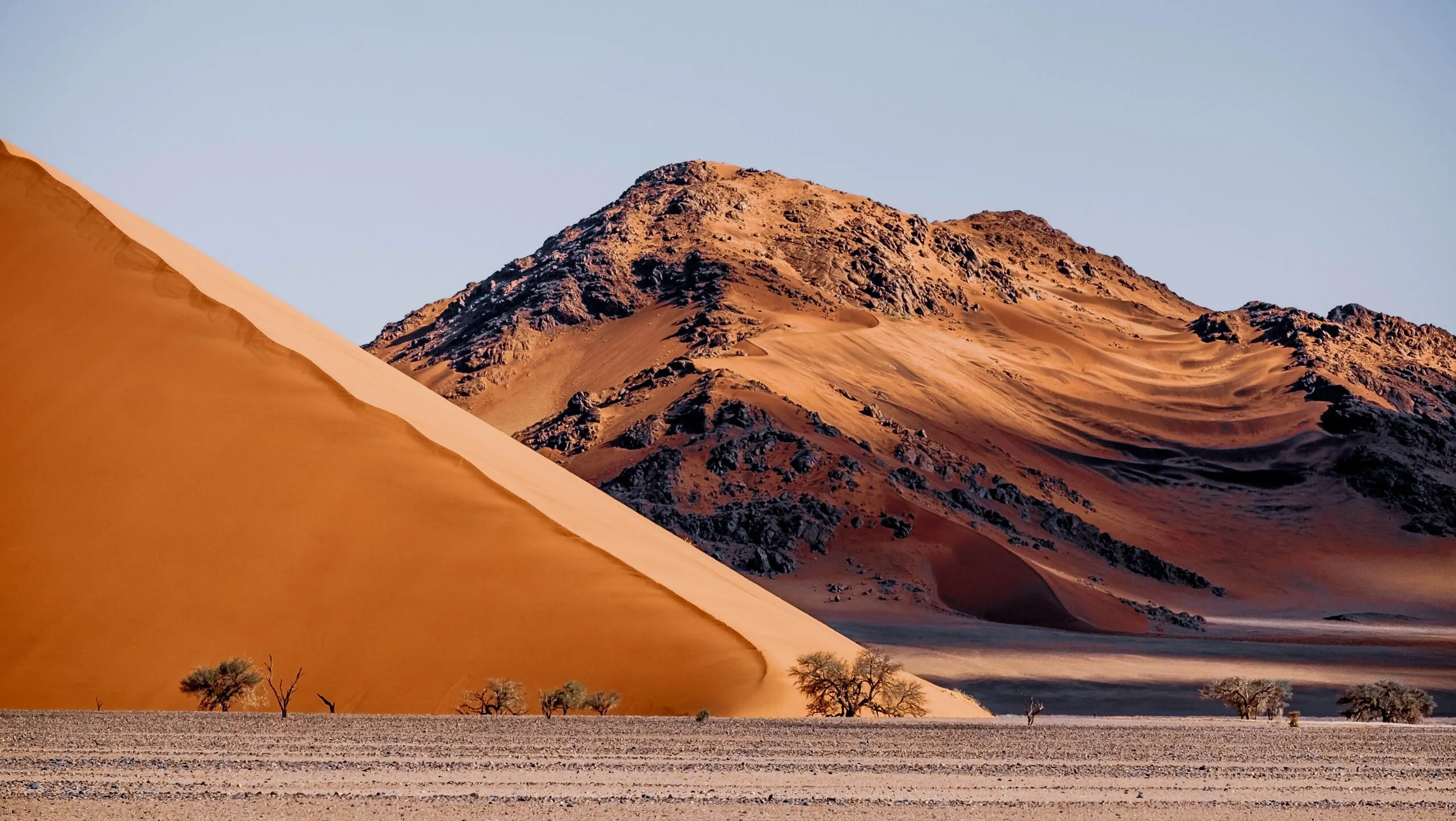
Practically, stargazing shapes where you sleep more than what you do. Camping puts you under it by default, which is why a fourteen-day camping route tends to deliver more sky than a lodge trip at the same price. The darkest skies sit over the Namib Sand Sea World Heritage Site, and since the best months for the galactic core are also the dry winter, it is worth reading when to visit Namibia alongside this.
Frequently asked questions
Where is the best stargazing in Namibia?
The NamibRand Nature Reserve, certified as an International Dark Sky Reserve by DarkSky International in 2012. Sossusvlei and the wider Namib are excellent generally, and several guest farms in the Khomas Highlands exist specifically for astronomy.
When is the best time for stargazing in Namibia?
The Milky Way’s galactic core is well placed from roughly June to August, with September still viable as the core sets earlier. Aim for the week around new moon; a full moon washes out everything but the brightest objects.
What can you see in Namibia that you cannot see from Europe?
The Large and Small Magellanic Clouds and the Southern Cross, both visible to the naked eye, and the galactic core of the Milky Way at an altitude northern observers never get. Omega Centauri is also visible as a naked-eye smudge.
Is NamibRand a Gold Tier reserve?
The reserve says so on its own website, and describes itself as Africa’s first International Dark Sky Reserve. DarkSky International’s own listing confirms the 2012 certification but does not use the words “Gold” or “tier”. Both are corroborated independently, though: contemporary science-press coverage of the 2012 certification reports the Gold Tier designation and the Africa-first status. What is not correct is calling NamibRand the only Dark Sky Reserve in Africa, since DarkSky now lists others.
Can you visit an observatory in Namibia?
Some. Several guest farms in the Khomas Highlands run astronomy programmes, and andBeyond Sossusvlei Desert Lodge has an observatory with a 12-inch Meade telescope and a resident astronomer. The H.E.S.S. gamma-ray array is a research facility, not a visitor attraction.
Do you need a telescope?
No. The Magellanic Clouds, the Southern Cross and the galactic core are all naked-eye objects under this sky. A pair of binoculars adds more than most people expect; a telescope is a bonus, not a requirement.
Desert Tracks plans Namibian routes around the moon as readily as the season. Tell us when you can travel and we will tell you what the sky will be doing. Tell us what you want out of the trip rather than when you can travel, and we will tell you honestly whether your dates fit — including when the answer is that they do not. Get in touch with Desert Tracks.