Namibia’s UNESCO World Heritage Sites
Namibia has two UNESCO World Heritage Sites: Twyfelfontein or ǀUi-ǁaes, inscribed in 2007 for its rock engravings, and the Namib Sand Sea, inscribed in 2013 on all four natural criteria. A third nomination, Dâures/Brandberg, went to UNESCO on 29 January 2026., the dry winter. Rainfall is near zero, wildlife concentrates at Etosha’s waterholes, and roads are at their best. July and August are the peak — and the coldest, near 6 °C at dawn.
Two sites sounds modest for a country this size. What the number hides is that one of them is 30,000 square kilometres of dune field that qualified on every natural criterion UNESCO has, and that a third nomination is sitting in Paris right now waiting on a decision expected in 2027.
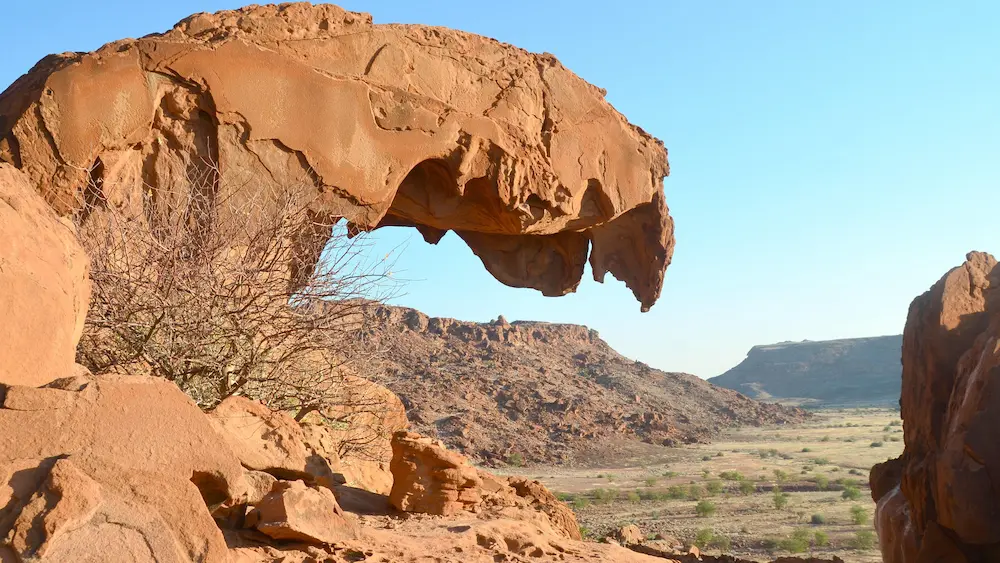
Twyfelfontein, 2007 — the first
Twyfelfontein was inscribed on 29 June 2007 under the full name Twyfelfontein or ǀUi-ǁaes, making it Namibia’s first World Heritage Site. It went in on cultural criteria (iii) and (v), for a rock-engraving concentration UNESCO calls one of the largest in Africa, accumulated over at least two millennia of hunter-gatherer ritual practice.
The engravings themselves — how many, how old, and the argument about both — are worth their own treatment, and we have given them one in our guide to Namibia’s rock art and where to see it. What matters here is the designation: inscription brought compulsory guiding, a management plan in 2005, and protection under the National Heritage Act of 2004.
The Namib Sand Sea, 2013 — and why it is the remarkable one
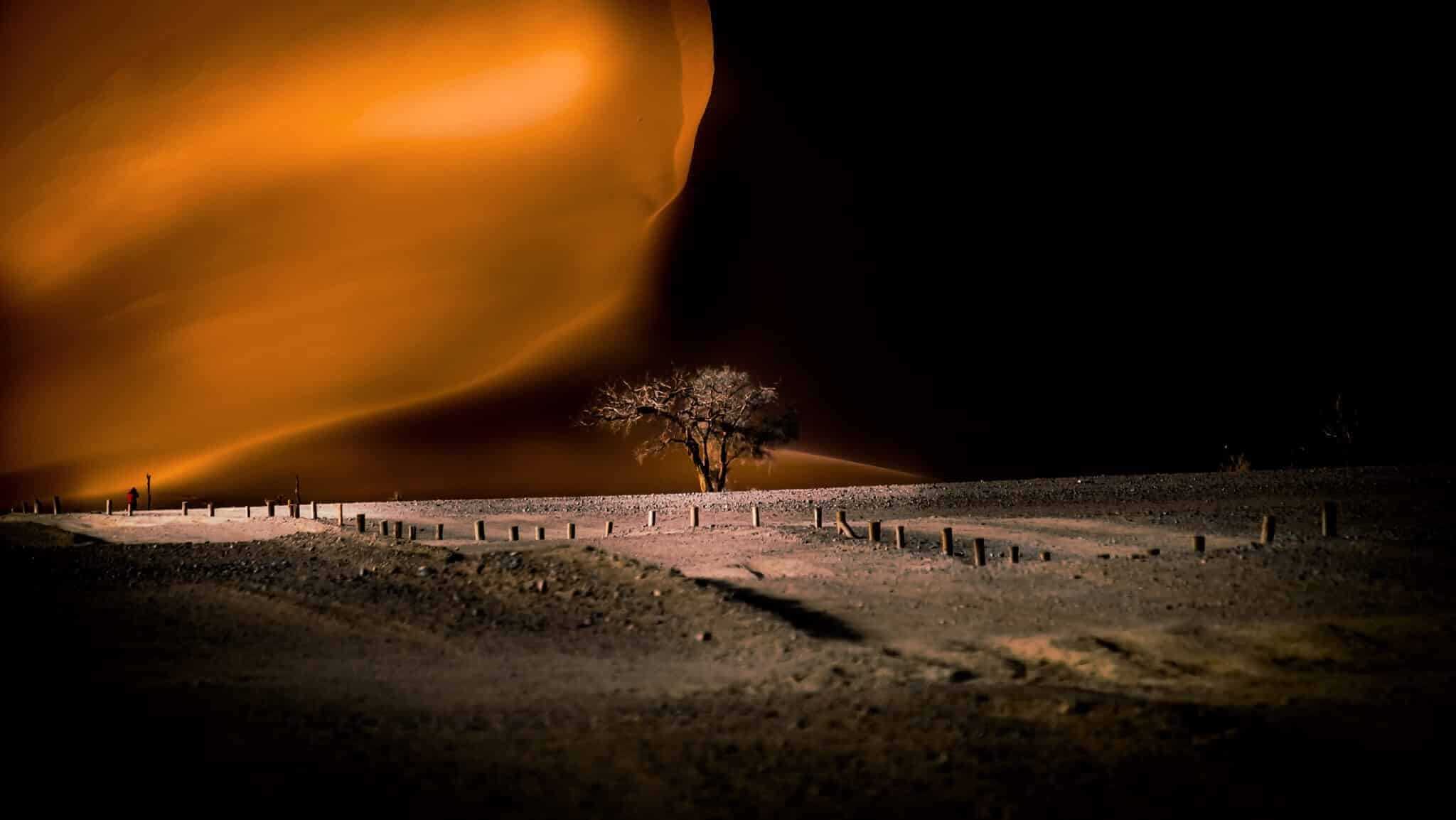
The Namib Sand Sea was inscribed on 21 June 2013 across 3,077,700 hectares, with an 899,500-hectare buffer, and it did something unusual: it met all four of UNESCO’s natural criteria — vii, viii, ix and x. Few sites anywhere manage that.
The reason is fog. UNESCO calls it the only coastal desert in the world with extensive dune fields influenced by fog, and that fog is not scenery — it is the water supply for an entire endemic community of invertebrates, reptiles and small mammals. The dunes themselves are two generations deep, younger active sand lying over older semi-consolidated dunes, built from material carried thousands of kilometres by rivers, ocean currents and wind before the desert ever got hold of it.
It is a World Heritage Site you can walk on
People assume UNESCO status means restricted access. Here it does not. Sossusvlei and Sesriem sit inside the inscribed property and draw roughly three quarters of all Namib-Naukluft Park visitors — Sossusvlei alone recorded 198,162 visitors in 2023. Sandwich Harbour, a Ramsar wetland, is also inside it.
Access is managed rather than closed. Most of the desert interior and the Atlantic coastline are 4×4 only, two shuttle concessions operate, and climbing is permitted on four named dunes — Dune 40, Dune 45, Big Daddy and Big Mama. Everything else you see people scrambling up in photographs is either one of those four or somewhere they should not be.
The IUCN’s conservation assessment lists the real pressures: illegal off-road driving and sanitation from tourism, eleven documented invasive plant species plus feral cats arriving via seasonal river flooding, and — rated as high potential threats — upstream water impoundment and groundwater extraction in the Kuiseb valley, and climate change altering the fog and wind regimes the whole ecosystem depends on. The park runs on an annual operating budget of about US$850,000, which IUCN assessors describe as barely adequate for a site this size.
The third site, currently in Paris
Namibia’s Cabinet approved a nomination for the Dâures/Brandberg National Monument Area in late 2025, and government confirmed to Parliament that the complete dossier was submitted to UNESCO on 29 January 2026, ahead of the 1 February deadline. The World Heritage Committee is expected to review it by July 2027.
The dossier’s own claims are worth reading carefully, because the numbers move depending on who is describing them: the minister’s parliamentary statement cited over 900 rock-art sites covering approximately 5,000 years of human history, with a ten-kilometre buffer zone. Earlier reporting described more than 120 archaeological sites. The British Museum, describing the Brandberg generally rather than the nomination, records around 1,000 sites and some 50,000 individual figures.
Whatever the count, a successful inscription in 2027 will change visitor numbers at the Brandberg the way 2007 changed them at Twyfelfontein. The window for seeing it quietly is roughly the next two years.
Namibia also carries a tentative list — Fish River Canyon, the Welwitschia Plains, Etosha Pan, the Sān Living Cultural Landscape and others — so this is not the end of the story. Seeing both current sites properly means covering the north-west and the Namib in one trip, which is what a full-country route is for. And since the Sand Sea sits under some of the darkest skies on earth, it pairs naturally with where to go stargazing in Namibia.
Frequently asked questions
How many UNESCO World Heritage Sites does Namibia have?
Two. Twyfelfontein or ǀUi-ǁaes, inscribed in 2007, and the Namib Sand Sea, inscribed in 2013. A third nomination, for Dâures/Brandberg, was submitted to UNESCO on 29 January 2026.
When will Namibia know about the Brandberg nomination?
The World Heritage Committee is expected to review it by July 2027. If it succeeds, Dâures/Brandberg becomes Namibia’s third World Heritage Site.
How big is the Namib Sand Sea site?
The inscribed area is 3,077,700 hectares — about 30,777 square kilometres — with a further 899,500-hectare buffer zone. It sits inside Namib-Naukluft National Park.
Can you actually visit the Namib Sand Sea?
Yes. Sossusvlei and Sesriem sit inside it and account for around three quarters of Namib-Naukluft Park visitors; Sossusvlei alone recorded 198,162 visitors in 2023. Sandwich Harbour is also within the property.
Which dunes can you climb?
Tourist climbing is permitted on four named dunes: Dune 40, Dune 45, Big Daddy and Big Mama. Most of the desert interior and the coastline are restricted to 4×4 access.
What makes the Namib Sand Sea unique?
UNESCO describes it as the only coastal desert in the world with extensive dune fields shaped by fog. It was inscribed on all four natural criteria — one of relatively few sites worldwide to meet every one.
Desert Tracks builds Namibian journeys around the places that justify the drive. Tell us how long you have and we will shape the route. Tell us what you want out of the trip rather than when you can travel, and we will tell you honestly whether your dates fit — including when the answer is that they do not. Get in touch with Desert Tracks.