Rock Art in Namibia: Where to See the Engravings
Namibia’s main rock-art sites are Twyfelfontein, a UNESCO World Heritage Site with over 2,000 engravings; the Brandberg, home of the misnamed White Lady; Spitzkoppe; and Phillipp’s Cave. Twyfelfontein can only be visited with a conservancy guide., the dry winter. Rainfall is near zero, wildlife concentrates at Etosha’s waterholes, and roads are at their best. July and August are the peak — and the coldest, near 6 °C at dawn.
Namibia holds the oldest known figurative rock art in Africa — seven painted slabs from Apollo 11 Cave in the far south, dated to roughly 30,000 years ago. It also holds one of the continent’s densest concentrations of engravings, a mountain covered in 50,000 painted figures, and a famous panel whose name is wrong in both of its words. What it does not hold is a settled set of numbers, and that is worth knowing before you read anyone else’s confident ones.
Twyfelfontein, and why the counts do not agree
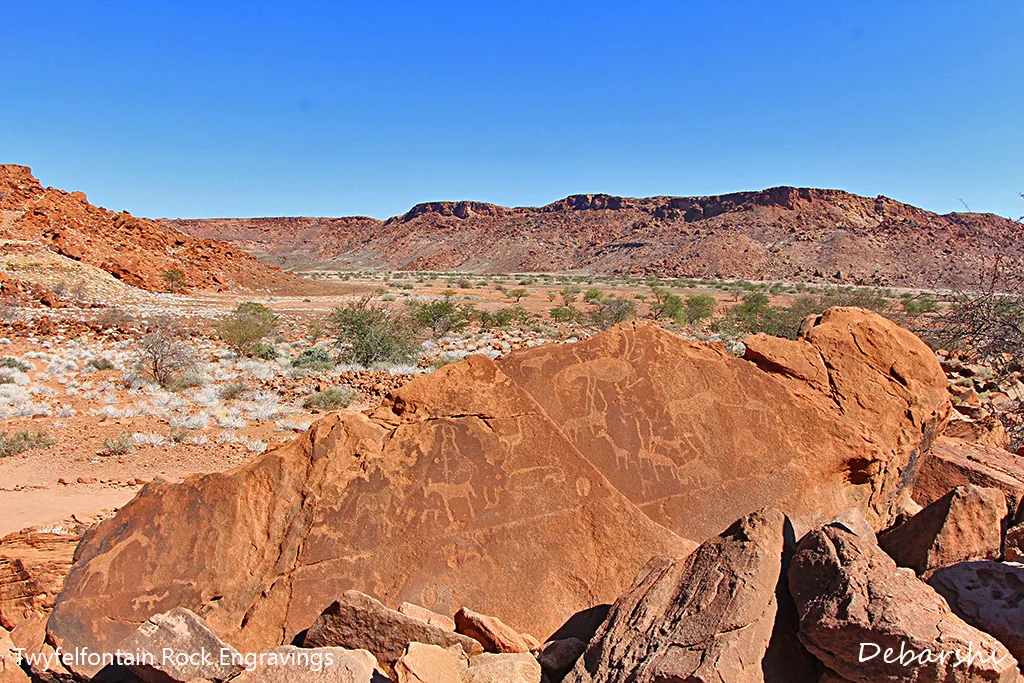
Twyfelfontein — inscribed by UNESCO in 2007 under its full name, Twyfelfontein or ǀUi-ǁaes — was Namibia’s first World Heritage Site. It was already a national monument, declared in 1952, reportedly to stop pieces being carried off.
How much art is there? UNESCO and Namibia’s National Heritage Council both say over 2,000 engravings. The British Museum’s Africa Rock Art project says well over 2,000 individual images and calls it the largest known discrete collection of engraved rock art in southern Africa. Other published sources give 2,500 across 212 sandstone slabs, and one modern estimate runs past 5,000 depictions. The ages disagree just as widely: UNESCO says at least two millennia, the Heritage Council says around 6,000 years, and other estimates stretch to 10,000. Anyone quoting you one number is picking a side.
What a visit actually involves
Independent wandering ended with UNESCO inscription. Entry is now only with a guide from the Uibasen-Twyfelfontein Conservancy, whose staff are local Damara residents, even though the engravings themselves are the work of San hunter-gatherers. The standard circuit runs about 500 metres over uneven, boulder-strewn ground and takes roughly an hour; an extended route of around two and a half hours reaches further panels.
The National Heritage Council sets rock-art site fees annually and the same schedule covers Twyfelfontein, the Petrified Forest and the White Lady. They rose by up to 150 per cent around 2022 and again on 1 April 2024. Check the current figure rather than budgeting from an older guidebook.
The White Lady is neither white nor a lady
The Brandberg is Namibia’s highest mountain and, on the British Museum’s count, carries around 1,000 rock-art sites and some 50,000 individual figures. Its most famous panel was recorded by the German surveyor Reinhard Maack — sources place this in 1917, and one gives an exact date of 4 January 1918.
The French prehistorian Abbé Henri Breuil saw Maack’s sketches and concluded the central figure was a young white woman of Mediterranean or Minoan origin, drawing comparisons with Bronze Age frescoes at Knossos. The dates attached to Breuil’s pronouncements vary by source — 1929 for the sketches, 1945 or 1947 for a visit, publication in 1948 and 1955. What is not in doubt is the outcome: the figure is male, carries a bow and arrows, and is now read as a shaman in ritual. The painting is San work. Breuil’s theory is universally rejected, and the name survives only out of habit.
These sites are fragile, and it shows
Twyfelfontein has a documented history of damage: pieces removed before formal protection, visitor graffiti on the slabs, and a lodge permitted by the conservancy in 1999 within the Seremonienplatz engraving area, which UNESCO’s own record says severely compromised the integrity of the engravings there. Conditions have since improved under a 2005 management plan and the National Heritage Act of 2004.
At the Brandberg the damage was cruder. Visitors wrote their names on the rock beside the paintings, added artwork of their own, and at one point it was popular to splash lemon juice on the pigment to make it photograph better. The panel is now fenced, with a marked path and parking area. If you take one thing from this post, let it be that these are not renewable.
The rock art was made by San hunter-gatherers. The sites today are managed and guided largely by Damara communities, and the two are not the same people. It is worth understanding that distinction rather than collapsing it — our guide to the peoples of Namibia sets out who is who.
Rock art sits naturally alongside the north-west’s other draws, and most people reach it on a longer loop — a sixteen-day northern route takes in Damaraland, the Kunene and Etosha with time to do Twyfelfontein properly rather than in forty minutes. If the names themselves interest you, what Namibian place names actually mean covers the same ground from a different angle.
Frequently asked questions
How old is the rock art at Twyfelfontein?
Nobody can tell you precisely. UNESCO says the art spans at least two millennia; Namibia’s National Heritage Council estimates around 6,000 years; other published estimates run from 1,000 to 10,000 years. There is no single agreed figure.
How many engravings are there at Twyfelfontein?
UNESCO and the National Heritage Council both say over 2,000. The British Museum says well over 2,000 and calls it the largest known discrete collection of engraved rock art in southern Africa. Other sources give 2,500 and even 5,000 or more.
Can you visit Twyfelfontein without a guide?
No. Independent walking through the engraving site ended after UNESCO inscription in 2007. Entry is only with a guide from the Uibasen-Twyfelfontein Conservancy. The standard circuit is about 500 metres over rough ground and takes around an hour.
What does it cost to visit?
Entry was raised to N$270 per adult on 1 April 2024, with N$220 reported for ages 8 to 17. The National Heritage Council sets these fees annually and the same schedule covers the Petrified Forest and the White Lady.
Is the White Lady a woman?
No. Anatomical review shows the central figure is male, carrying a bow and arrows, and is now generally read as a shaman in ritual. The name comes from a misidentification by the French prehistorian Abbé Henri Breuil, who proposed a Mediterranean origin. That theory is universally rejected.
Where is the oldest rock art in Africa?
Apollo 11 Cave in southern Namibia. Seven painted stone slabs from the site date to approximately 30,000 years ago — the oldest known figurative rock art on the continent.
Desert Tracks builds Namibian journeys that give the rock-art sites more than a photo stop. Tell us what interests you and we will shape the route around it. Tell us what you want out of the trip rather than when you can travel, and we will tell you honestly whether your dates fit — including when the answer is that they do not. Get in touch with Desert Tracks.