Do I Need a 4×4 in Namibia?
No — you do not need a 4×4 in Namibia for the standard circuit; a 2WD is enough. The last five kilometres to Deadvlei are the single exception, and since May 2026 that stretch is 4×4-or-shuttle by law.
That answer will cost us money, so let us be clear about why we are giving it. Almost every page you will find on this question is published by someone who rents vehicles, and the more capable the vehicle, the better the day they have. We book both. We would rather you spend the difference on an extra night in Damaraland than on a Land Cruiser that spends two weeks on tar.
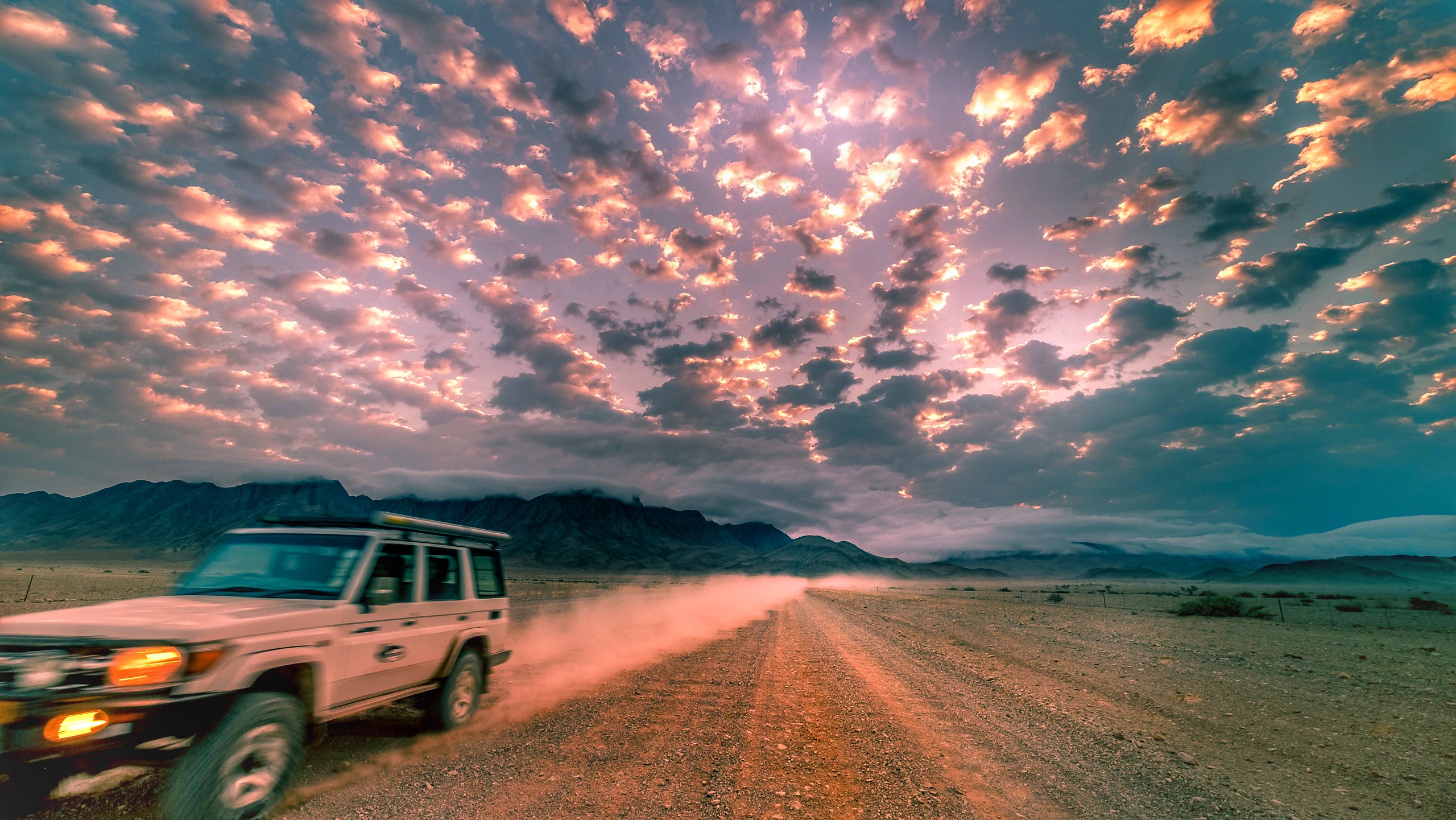
But “you don’t need a 4×4” is only true if you know where the boundary sits. Below is where it actually sits — route by route, with the four ways a 2WD genuinely does catch people out, and what the rental insurance will and will not carry when it does.
Where a 4×4 in Namibia Is Now a Legal Requirement
Sossusvlei is the exception that people get wrong, and the rules moved recently enough that most published advice is out of date.
The road from the Sesriem gate to the 2×4 car park is tar, about 60 km, and any car will do it. The last 5 km from that car park to Sossusvlei and Deadvlei is deep, soft sand. That stretch has always defeated 2WD vehicles. What changed is who is allowed on it at all.
On 1 May 2026 the Ministry of Environment, Forestry and Tourism restricted that final stretch to the concessionaire’s shuttle and registered operators, effectively ending self-drive access. On 2 May 2026 it reversed that decision. The position now, per MEFT, is that three groups may use the sand track:
- Guides registered with the Namibia Tourism Board
- Self-drivers in a 4×4
- Anyone on the concessionaire’s shuttle
Buses and trucks are not permitted. The shuttle, which was briefly mandatory, is optional again — it runs from the 2×4 car park and was last publicly listed at around N$250 per adult and N$125 per child under 12, though the concession’s pricing has moved more than once and you should confirm it when you book.
If you are in a 2WD, you have not lost Deadvlei — you drive the tar to the car park and take the shuttle for the last 5 km, which is what a large share of visitors have always done. The camps inside the gate are run by Namibia Wildlife Resorts, and they book out months ahead in high season. If you are in a 4×4, you may drive it yourself. Either way, you get there. The only thing a 2WD costs you here is about N$250 a head and the ability to sit at the vlei on your own schedule.
Route by Route: Where You Need a 4×4 in Namibia
Dry season, May to October, unless noted. Green season changes several of these — see further down.
The Four Ways a 2WD actually Catches People Out
Only one of these is about drive at all. That is rather the point.
1. Soft sand — the only true capability wall
Deadvlei’s last 5 km, Sandwich Harbour, the Kaokoveld riverbeds, the Khaudum tracks. In soft sand a 2WD does not struggle, it stops, and then you are digging. Everywhere else on a normal itinerary, sand is not the surface you are on.
2. Ground clearance matters more than a 4×4 in Namibia
Most of the trouble we see blamed on “not having a 4×4” is actually clearance: a washaway on a D-road, a steep concrete drift, a rutted lodge access track. A high-clearance 2WD bakkie handles nearly all of it. If you are choosing between a low sedan and a raised 2WD, take the raised one — that upgrade buys you far more than the jump to 4×4 does.
3. Corrugation and the fourth hour
This is the honest case for the bigger vehicle, and it is about the driver, not the road. Namibian gravel corrugates. A sedan transmits all of it, and by hour four you are tired, and tired is when people make the mistake in point 4. A heavier vehicle with better suspension lets you hold a sensible speed and arrive functional. If your itinerary has several 350–450 km gravel days back to back, that comfort is a safety argument, not a luxury.
4. Green season
December to April, gravel becomes slick, drifts run, and D-roads can close without notice. If you are travelling in those months and going anywhere off the tar, the calculation genuinely changes.
What a 4×4 in Namibia Costs — Including the Part Nobody Quotes
The daily rate difference is the part people compare. The part they do not check until it is too late is what the standard insurance does not carry — and on Namibian gravel, those exclusions are the ones that bite. Across Windhoek rental companies, standard cover typically excludes:
- Tyres, windscreen and rims. The three things gravel actually damages.
- Undercarriage damage. Not covered on standard cover, and often not on the mid-tier reduced-excess options either.
- Single-vehicle accidents, including rollovers. At one Windhoek operator the renter’s liability on a single-vehicle incident runs to N$165,000 unless the top excess-reduction tier is bought.
- Water damage where the water reaches above the axle — relevant in green season.
- Sandblasting, unless you buy the highest tier.
- Negligent driving, which includes speeding — and see the next section on what “speeding” means on gravel.
So the real comparison is not “sedan versus 4×4 per day”. It is the vehicle plus the excess-reduction tier that actually covers tyres, glass and a rollover. Run that sum and the gap between a 2WD and a 4×4 narrows considerably — which is another reason we would rather talk you into the right insurance than the bigger car.
The Thing That Matters More than the Vehicle
Namibia’s legal limits are 120 km/h on tar and 100 km/h on gravel. The second of those numbers is the most dangerous piece of information in this article, because the limit is not the safe speed.
80 km/h is the working ceiling on gravel, and it is what experienced local drivers hold to. Above roughly 100 the vehicle is riding on top of loose stone, braking distances stretch badly, and a correction that would be nothing on tar becomes a rollover. Serious single-vehicle accidents in Namibia cluster above that speed. This is not a 2WD problem — if anything it is a 4×4 problem, because a high-sided vehicle rolls more readily and gives the driver more confidence than the surface deserves.
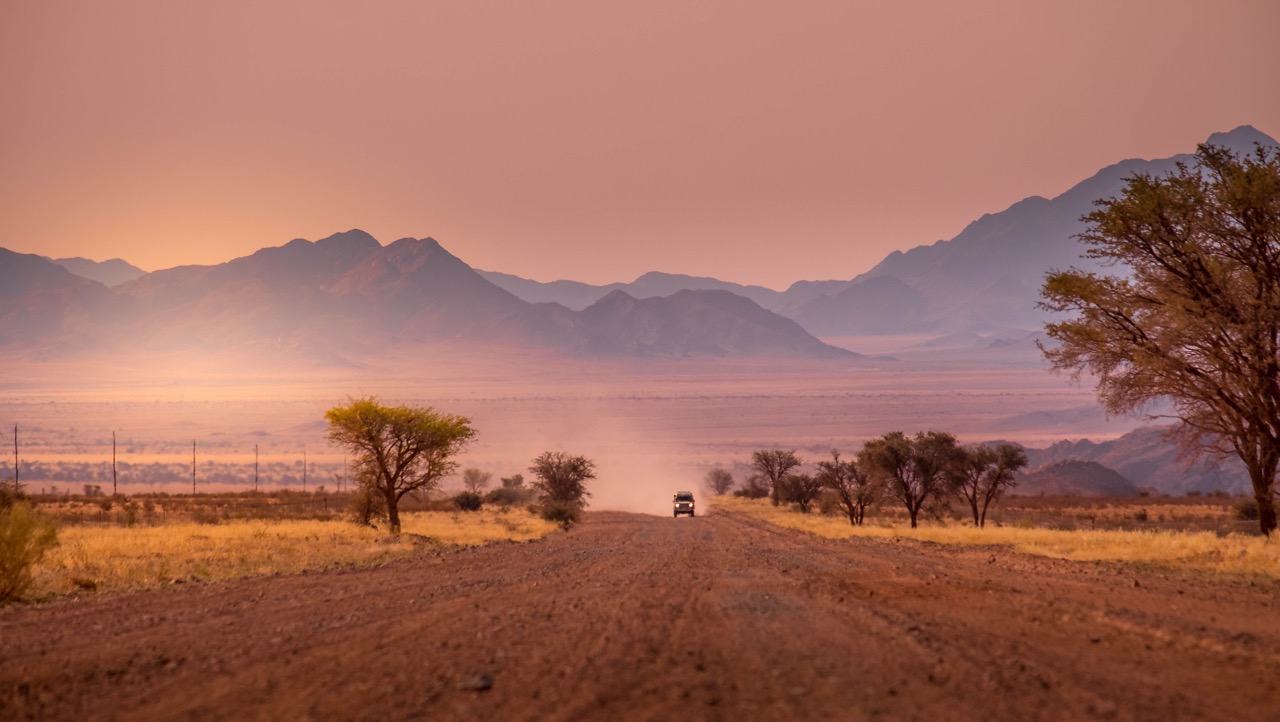
Two habits do more for your safety than any drivetrain:
- Drop your tyre pressures. From roughly 2.0–2.2 bar road pressure down to about 1.6 bar for long gravel sections, and around 1.2 bar in genuine soft sand. Fewer punctures, better grip, less shaking. Reinflate before you go back on tar.
- Do not drive at night. Kudu, warthog and cattle on unfenced roads, at dusk especially. Plan every day to arrive before sunset, and treat that as a hard rule rather than a preference.
So Which Vehicle Should You Book?
Common Questions About Driving a 4×4 in Namibia
Can I still see Deadvlei in a 2WD?
Yes. Drive the 60 km of tar from Sesriem to the 2×4 car park and take the concessionaire’s shuttle for the final 5 km — last listed at around N$250 per adult and N$125 per child under 12. Confirm the current rate when booking.
Do you need a 4×4 in Namibia’s Etosha National Park?
No. Etosha’s internal roads are graded gravel and calcrete and are fine in a sedan. After heavy rain some loops close for all vehicles.
What is the difference between a B, C and D road?
B-roads are the main tarred routes. C-roads are main secondary roads, mostly well-graded gravel and fine in 2WD. D-roads are minor district roads, gravel, more variable, and the ones most affected by rain. Namibia has been progressively upgrading D-roads to C-roads, so old maps and old advice can disagree with the signage.
How fast can I drive on gravel in Namibia?
The legal limit is 100 km/h. The sensible limit is 80. Most serious single-vehicle accidents happen above 100.
Will my rental insurance cover a puncture?
Usually not. Tyres, windscreen and rims are excluded from standard cover at most Namibian rental companies, and are only picked up by the highest excess-reduction tiers. Check the specific wording before you sign.
Do I need a 4×4 to cross into Botswana?
Not for the tarred border routes, but you do need a cross-border letter from the rental company, arranged in advance, plus the Botswana entry fees.
Desert Tracks is a Namibian destination management company based in Swakopmund, arranging self-drive, guided and fly-in safaris across Namibia, Botswana and Zimbabwe.
Planning a self-drive and not sure which vehicle your route needs? Send us the itinerary and we will tell you honestly — including when the answer is that you do not need the bigger car.