Kolmanskop: The Diamond Town the Desert Took Back
Kolmanskop is the most photographed ruin in Namibia and the most confidently mis-described. Almost every account of it repeats two superlatives that no source supports. The documented history is stranger than either of them.
Kolmanskop is an abandoned German diamond-mining town outside Lüderitz, founded after a railway worker found a diamond there in April 1908 and abandoned in 1956. It is open to visitors daily with guided tours at 09:30 and 11:00, and a separate photography permit covers sunrise to sunset., the dry winter. Rainfall is near zero, wildlife concentrates at Etosha’s waterholes, and roads are at their best. July and August are the peak — and the coldest, near 6 °C at dawn.
What actually happened in April 1908
Zacharias Lewala, working on the railway line, picked up a stone and showed it to August Stauch, the German inspector he worked under. Stauch understood what it was. Lewala was never paid and never credited. Within months the German colonial administration had proclaimed the Sperrgebiet — the forbidden zone — in September 1908, and the entire coastal strip was closed.
It is still closed. The area is now Tsau ǁKhaeb National Park, 26,000 square kilometres, about three per cent of Namibia, with mining on roughly five per cent of that and the rest shut to the public since 1908. Access to anywhere beyond Kolmanskop runs through Namdeb and the police Protected Resources Unit, and takes at least six working days to arrange.

The claims to drop, and what replaces them
Three things are repeated about Kolmanskop by almost everyone writing about it, and none of the three can be traced to a source that says what the repetition says.
Why the sand won
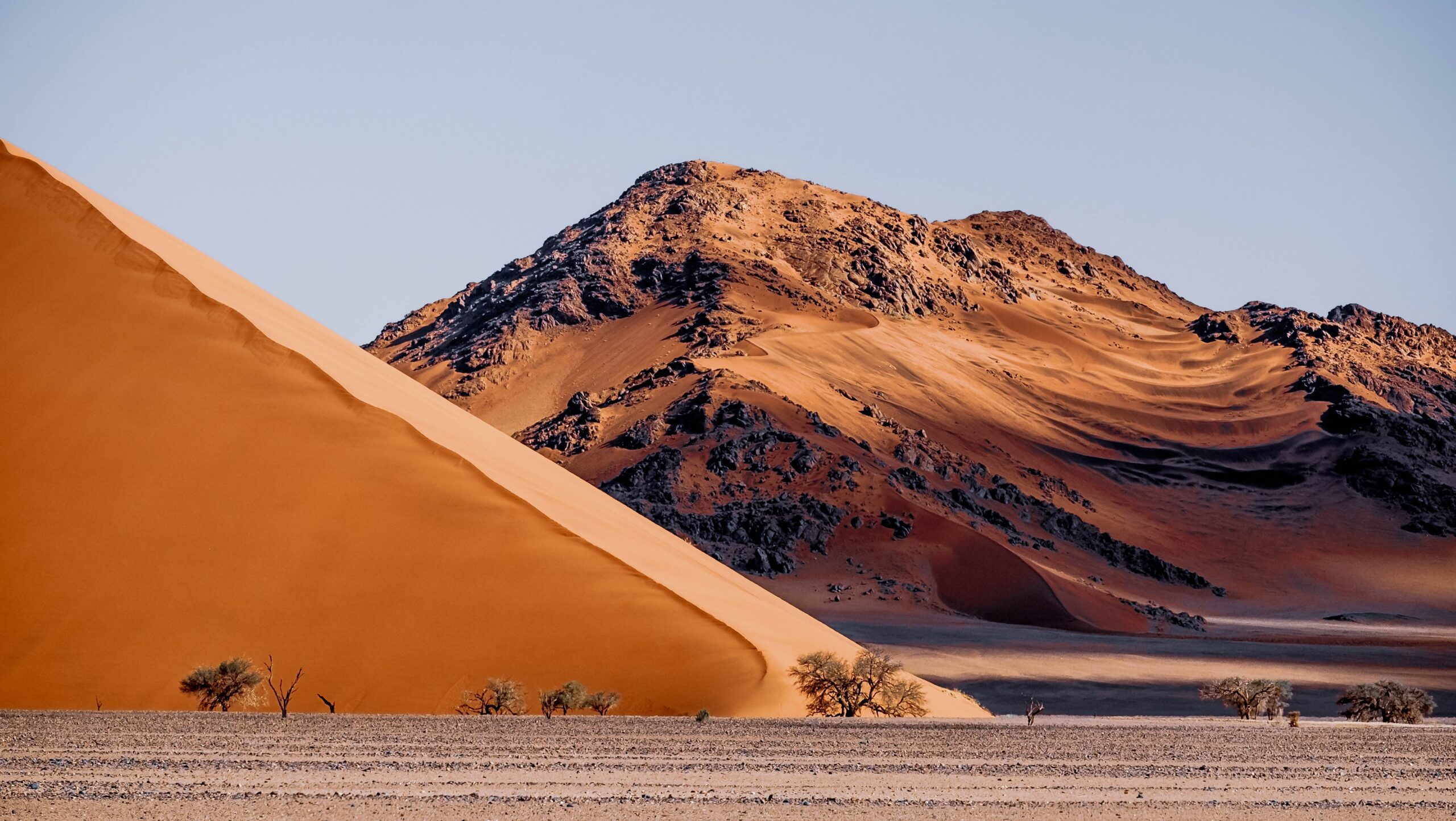
The diamonds near the surface ran out and richer fields opened further south. The town emptied over decades and was finally abandoned in 1956. What makes it photograph the way it does is what happened next: nothing, except wind. There is no vegetation to hold the sand and nobody to shovel it, so it has been coming through the windows and doors for seventy years and filling the rooms floor by floor.
Visiting, and what it costs
Guided tours run Monday to Saturday at 09:30 and 11:00, and 10:00 on Sundays and public holidays. That timing is the single best-corroborated fact about the place — four independent sources agree on it. Permits are sold online, at the entrance gate, or at The Desert Deli in Lüderitz on the corner of Bahnhof and Moltke streets, and the operator publishes its tour times and permit prices directly.
The photography permit is the one worth planning around: N$350 to N$400 per person, valid sunrise to sunset, which is the only way to be in the houses when the light is low enough to be worth the trip. Night photography is not permitted. On the standard entry price we have seen N$150 to N$180 quoted by the operator and N$90 reported by a visitor in May 2025 — ask at the gate rather than budgeting on a number off a website. If photography is the point of your trip, our note on where to photograph in Namibia’s parks covers the rest of the country.

Where it sits on a route
Kolmanskop is a morning, not a day, and Lüderitz is the reason to stay the night rather than turn around. It falls naturally on a southern loop with Fish River Canyon and the Kalahari — our 11-Day South of Namibia self-drive takes it that way, with Days 5 to 7 on the coast.
If the appeal is the history rather than the photography, it sits alongside the rest of the country’s colonial record — see our pieces on Namibia’s historical landscape and on what Namibia is actually known for. And whatever you do, eat the crayfish while you are in Lüderitz.
One honest note about the photographs on this page: we have exactly one picture of Kolmanskop itself in our library, and it is the one at the top. The others are the road in and the country around it, captioned as such. We would rather tell you that than pass off a dune as a doorway.
Frequently asked questions
When can you visit Kolmanskop?
Guided tours run Monday to Saturday at 09:30 and 11:00, and at 10:00 on Sundays and public holidays. A day pass covers self-guided walking, and a separate photography permit runs sunrise to sunset.
Do you need a photography permit?
Only for the sunrise and late-light hours outside normal opening. It costs N$350 to N$400 per person and does not cover night photography, which is not allowed.
Was Kolmanskop really the site of the first X-ray machine in the southern hemisphere?
There is no source for it. The claim is repeated everywhere and Wikipedia flags its own version as uncited. The strongest source supports only that the town had one of the finest X-ray plants in Southern Africa.
When was the town abandoned?
1956, about fifty years after the first diamond was picked up beside the railway line in April 1908.
Can you drive there yourself?
Yes. It sits on the B4 just outside Lüderitz, on tar. The restricted Sperrgebiet areas beyond it are a different matter and need a permit through Namdeb, with at least six working days’ notice.
Desert Tracks runs Kolmanskop on its southern Namibia routes, with nights in Lüderitz. Tell us what you want out of the trip rather than when you can travel, and we will tell you honestly whether your dates fit — including when the answer is that they do not. Get in touch with Desert Tracks.