Desert and Delta: Combining the Namib with the Okavango
The Namib and the Okavango are the two extremes of the same journey, and the road between them runs east through Namibia’s Zambezi region. The two things people get wrong: **the delta floods in the dry season**, peaking around June and July from rain that fell in Angola months earlier, and **Namibia has a delta of its own** — MEFT calls Nkasa Rupara a mini Okavango when the Kwando runs high., the dry winter. Rainfall is near zero, wildlife concentrates at Etosha’s waterholes, and roads are at their best. July and August are the peak — and the coldest, near 6 °C at dawn.
This is a genuinely long trip and we would rather set it out honestly than sell it. Below is what is actually documented: the designations, the distances we could source, the health line, and the border paperwork — plus a frank list of what nobody publishes.
The delta Namibia already has
Before you cross a border, it is worth knowing that the Ramsar-listed Okavango Delta System is not confined to Botswana. The site covers the Okavango River and the Kwando and Linyanti river system, and it is those same rivers that define Namibia’s Zambezi-region parks. MEFT describes Nkasa Rupara as the largest wetland area with conservation status in Namibia, and states that when flood waters from the Kwando are high the park becomes like a mini Okavango Delta. It holds around a thousand buffalo, the largest concentration in the country, and 430 bird species including wattled crane and slaty egret.
Bwabwata is the bigger and more accessible of the group, at 6,100 square kilometres, gazetted under its current name in 2007. Unusually, it is a multiple-use park with a core conservation area at each end and around five thousand people living in the middle — one of the last refuges of wild dog in Namibia, with two conservancy-run tourism facilities on the Kwando. Mudumu covers 1,010 square kilometres, proclaimed in 1990.
The UNESCO property and the Ramsar site are not the same shape and the figures are not interchangeable. The Ramsar site is much larger because it takes in the Kwando and Linyanti system as well. Quoting one as “the size of the delta” without saying which is a mistake we see constantly.
Why the flood arrives in the dry season
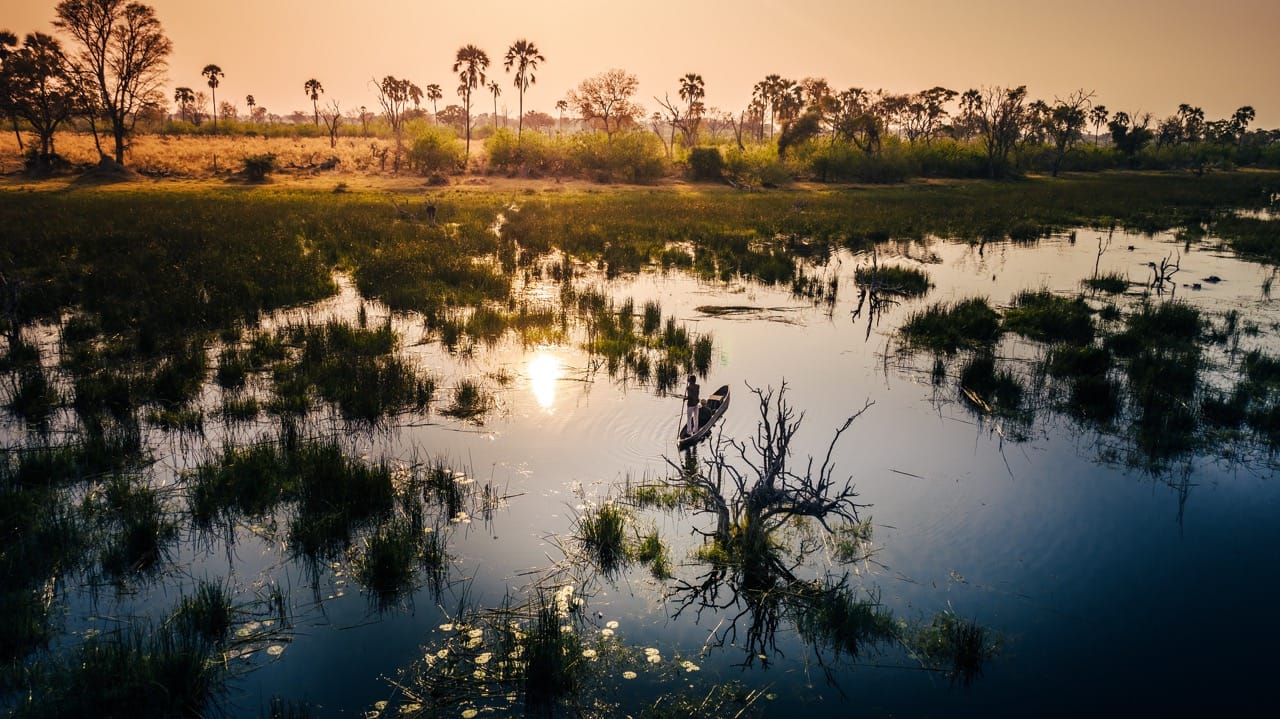
This is the fact that reorganises how you plan. UNESCO inscribed the Okavango Delta in 2014 under all three of criteria seven, nine and ten, and the reason it gives is precisely this: the annual flooding occurs during the dry season, and the plants and animals have synchronised their biological cycles to it rather than to the rain. IUCN’s evaluation puts the flood tide at the peak of Botswana’s dry season, June and July, and calls it a critical life force.
The water itself falls as summer rain in the Angolan highlands and takes months to arrive. So the delta is at its fullest when the surrounding country is at its most parched, and that is exactly when the game concentrates. It also means the delta and the Namib are at their best in the same window, which is the practical argument for combining them.
The Ramsar record for the system, designated in 1996 and covering 5,537,400 hectares, catalogues more than 1,060 plant species, 32 large mammals, over 650 birds and 68 fish. It is a working landscape too — used for recreation, tourism, subsistence farming and fishing.
An elephant number worth getting right
You will read that the Okavango Delta holds around 130,000 elephants. It does not. That figure is Botswana’s national population, and the delta is described as the core area for the species rather than the container for all of them. The 2022 KAZA aerial survey, flown to CITES standards across five countries, counted 227,900 elephants in the transfrontier area, of which Botswana held 131,909 — fifty-eight per cent of the region. The one figure with a published error term is northern Botswana at 126,637, standard error 5,856.
You will also read that Chobe has the highest concentration of elephants in Africa. That phrase does appear on a UNESCO page, but it is text Botswana itself submitted for a tentative-list entry in 2010, not a UNESCO finding and not a survey result. No aerial survey we could reach supports a density ranking. We are not going to repeat it.
What is defensible about Chobe: a park of roughly 11,700 square kilometres, national park status in 1968, with a riverfront that acts as a dry-season drinking point for elephant and buffalo, and four distinct sections — the Chobe riverfront, Savuti, Linyanti and Nogatsaa. Kasane, on the river, sits close to the point where four countries nearly meet.

The distances, and what nobody publishes
We can give you sourced legs. Rundu to Divundu is 200 kilometres. Divundu to the Mohembo border on the C48 via Bagani is 32 kilometres. From the Namibian side at Mohembo to Sehithwa on Botswana’s A35 is 296 kilometres. Katima Mulilo to Rundu is around 500 kilometres, Katima to the Ngoma border about 40, and Kasane to Ngoma 51. The B8, the Golden Highway, carries you the length of it from Otavi through Rundu and Divundu to Katima Mulilo.
What we will not give you is driving times, or totals produced by adding those legs together. No authority publishes journey times for these routes, and adding sourced distances to invent an unsourced total is exactly the kind of thing that puts people on a gravel road after dark. Ask us and we will tell you what our own drivers do it in.
Borders, visas and health
Namibia introduced a visa requirement on 1 April 2025, available on arrival or as an e-visa: N$1,600 for travellers over eleven, N$800 for ages six to eleven, free under six. Botswana admits British nationals visa-free for up to ninety days. Both want at least six months of passport validity and three blank pages, and both require an original or certified unabridged birth certificate for any child under eighteen — this catches families out more than anything else on the list. Botswana also requires you to declare cash of P10,000 or more.
On health, be specific rather than reassuring. Namibia’s own ministry flags Mudumu National Park as a high-risk malaria area requiring precautions. The UK’s NaTHNaC service records high malaria risk from October to May across the northern half of Botswana including the Okavango, dropping to low risk in the other months, with the southern half very low year-round. And the UK Foreign Office noted in 2026 that malaria had been reported spreading into areas of Botswana where it is not usually present. Get current advice close to departure rather than trusting a static map.
We could not find a single official source publishing border-post opening hours, cross-border vehicle permit fees, or the road-fund charges for either country, and the Botswana government page describing the Mohembo crossing still refers to a pontoon rather than a bridge. Nor could we confirm the current status of Botswana’s park entry fees: the government announced a rise from P380 to P500 for non-residents effective 1 April 2026, and trade press reported it postponed on 31 March 2026, but no ministry statement confirming the postponement was found. Do not budget from a blog post — including this one.
How we would actually shape it
Two weeks is the floor, and three is better. The honest version puts the Namib first while you are fresh, runs the Caprivi east as a slow, wildlife-heavy leg rather than a transit, and finishes on water in Botswana. If your time is shorter, we would rather send you into Namibia’s own remote north properly than rush a border. If you have the time, our 11-day Botswana safari experience is the delta half done at the right pace, and the main Namibian self-drive circuit is the desert half. Botswana also runs its own version of the same pairing, if you would rather not cross a border at all: the 11-day Botswana desert and delta safari works Kalahari and Makgadikgadi through to the Okavango and Chobe.
Frequently asked questions
Can you combine the Namib desert and the Okavango Delta in one trip?
Yes, and it is one of the most rewarding pairings in southern Africa, but it is a long way. The route runs east along Namibia’s Caprivi strip and crosses into Botswana. It needs a minimum of about two weeks to avoid becoming a driving marathon.
Does Namibia have its own delta?
In effect, yes. MEFT describes Nkasa Rupara National Park as the largest wetland with conservation status in Namibia, and says that when the Kwando flood is high the park becomes like a mini Okavango Delta. The Ramsar-listed Okavango Delta System formally includes the Kwando and Linyanti river system that Namibia’s Zambezi parks sit on.
When does the Okavango Delta flood?
In Botswana’s dry winter, roughly June to August. The water falls as rain in the Angolan highlands months earlier and takes that long to arrive, which is why the delta is at its fullest when the surrounding country is at its driest.
Is the Okavango Delta a malaria area?
Yes. The UK health authority NaTHNaC records high malaria risk from October to May in the northern half of Botswana, including the Okavango Delta area, and low risk in the other months. Namibia’s own ministry describes Mudumu National Park in the Zambezi region as a high-risk malaria area. Get current advice before you travel.
Do I need a visa for Namibia and Botswana?
Namibia introduced a visa requirement on 1 April 2025, available on arrival or as an e-visa, at N$1,600 for travellers over eleven. Botswana admits British nationals visa-free for up to ninety days. Both require at least six months of passport validity and three blank pages, and both require an unabridged birth certificate for any child under eighteen.
We run both halves of this, Namibia and Botswana, so we have no reason to talk you into one over the other. Tell us how many nights you have and we will tell you honestly whether the delta fits. Tell us what you want out of the trip rather than when you can travel, and we will tell you honestly whether your dates fit — including when the answer is that they do not. Get in touch with Desert Tracks.