Places to Visit on Your Namibia Self-Drive Safari
The classic Namibian self-drive circuit is open and mostly 2WD-friendly, but three things changed recently. **Self-drive to Deadvlei was restricted on 1 May 2026 and restored on 2 May 2026** — you may drive it in a 4×4. Park fees rose on 1 April 2026 to N$280 per foreign adult per day. And fuel inside the parks has been unreliable since 2025, so fill up before the gate., the dry winter. Rainfall is near zero, wildlife concentrates at Etosha’s waterholes, and roads are at their best. July and August are the peak — and the coldest, near 6 °C at dawn.
This is the practical version: which stops need what vehicle, which need a permit bought in advance, which need a guide, and which one on every list is actually closed.
Sossusvlei and Deadvlei, and where access stands
This has been the most volatile access question in Namibia for two years, so the sequence matters. In October 2024 the five-kilometre sand section from the 2×4 parking to Sossusvlei was put under a 25-year shuttle concession. A proposed self-drive ban was announced and then postponed in December 2025. On 1 May 2026 the restriction was actually imposed, and it drew public criticism, including from a former environment minister. On 2 May 2026 MEFT issued a public notice reversing it.
The current position, per that notice: beyond the 2×4 parking, self-drive visitors in 4×4 vehicles may proceed, as may NTB-registered tour guides carrying their own clients and the concessionaire’s shuttle. Buses and trucks remain prohibited. The shuttle is optional. Tourism Update reported the notice with MEFT confirming the status quo remains.
Four different figures have appeared in reporting since 2024 — N$180, N$200, N$250 and N$260 — and no operator or ministry page confirms any of them. We are not going to pick one. Ask at Sesriem.
The drive itself: roughly 60 kilometres of paved road from the inner gate to the 2×4 parking at a 60 km/h limit, then about five kilometres of deep sand. Climbing is permitted on four named dunes only — Dune 40, Dune 45, Big Daddy and Big Mama. Sossusvlei recorded 198,162 visitors in 2023, and Sossusvlei with Sesriem accounts for roughly three quarters of all Namib-Naukluft visitors, so an early start is not a cliché here.
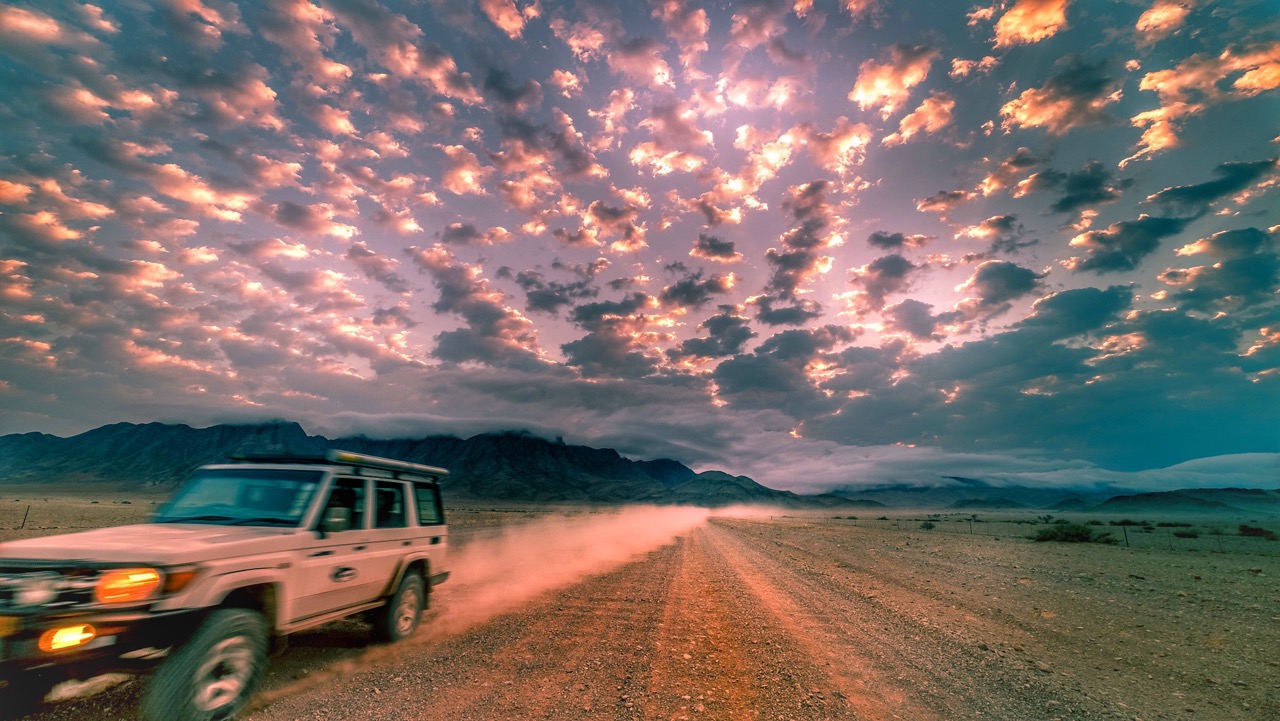
On gate times, be careful with what you read online. Multiple tourism sources agree that the outer Sesriem gate runs sunrise to sunset while the inner gate opens an hour before sunrise and closes an hour after — which is the whole argument for sleeping inside the gate. But no official MEFT or NWR page publishes gate times, and at least one well-known guide flatly contradicts the early-access claim. Confirm at reception on arrival; the inner gate time shifts with the season anyway.
Etosha
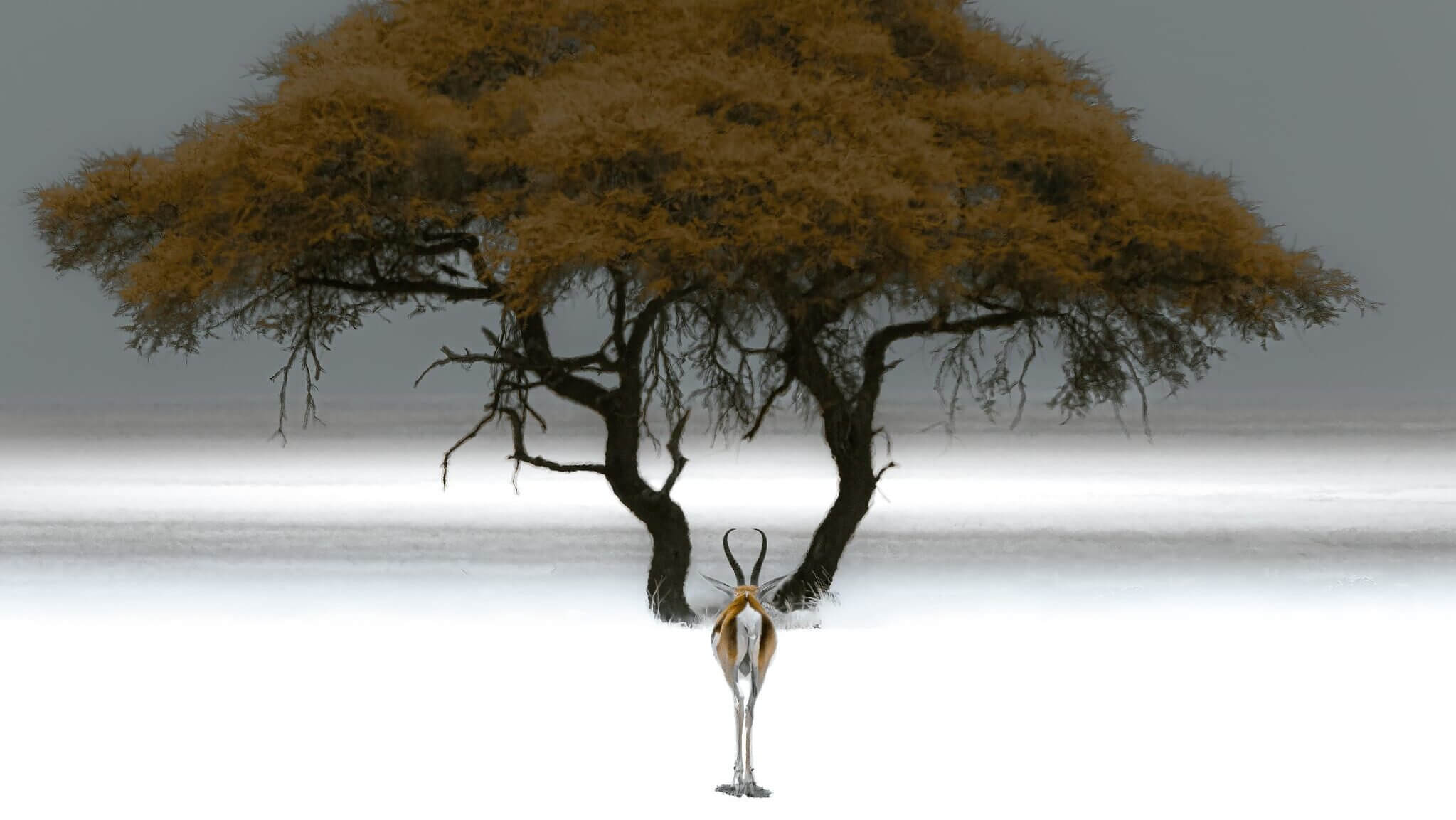
Namibia’s headline game park: 22,935 square kilometres, proclaimed in 1907. The main roads are fine in a 2WD through the dry season from May to October. A 4×4 becomes advisable in the wet season from November to April, and for the approach roads to Dolomite Camp on the restricted western side.
The rules are simple and enforced. Gates open at sunrise and close at sunset with seasonal variation. Night driving is prohibited for self-drive visitors. The speed limit is 60 km/h park-wide. And MEFT is explicit that in all parks, leaving the vehicle is prohibited — you get out at rest camps, designated picnic sites and viewpoints, and nowhere else. Permits are issued at the gate on arrival; NWR does not issue permits at all. Okaukuejo’s floodlit waterhole is the reason people book that camp specifically, and NWR describes it as viewable both during the day and at night.
Damaraland: Twyfelfontein, Spitzkoppe and the rock
Twyfelfontein is reached on the D2612 off the C39 — 2WD passable in dry conditions, 4×4 recommended. A guide is compulsory and included in the entry price. It was inscribed as a UNESCO World Heritage Site in 2007, with over 2,000 engravings documented. The Petrified Forest near Khorixas is a gravel road off the C39, 2WD, and guided walks only. The Organ Pipes and Burnt Mountain are signposted off the same D2612.
Spitzkoppe is reached on gravel from the B2 and is 2WD-accessible to the campsite, though high clearance helps after rain. The rest camp publishes a day-visit fee of N$180 per adult and N$120 for children aged four to eleven, valid to the end of October 2026, inclusive of VAT and the conservancy levy. Every visitor must present government-issued ID at the gate — worth knowing before you leave your passport in the safe.
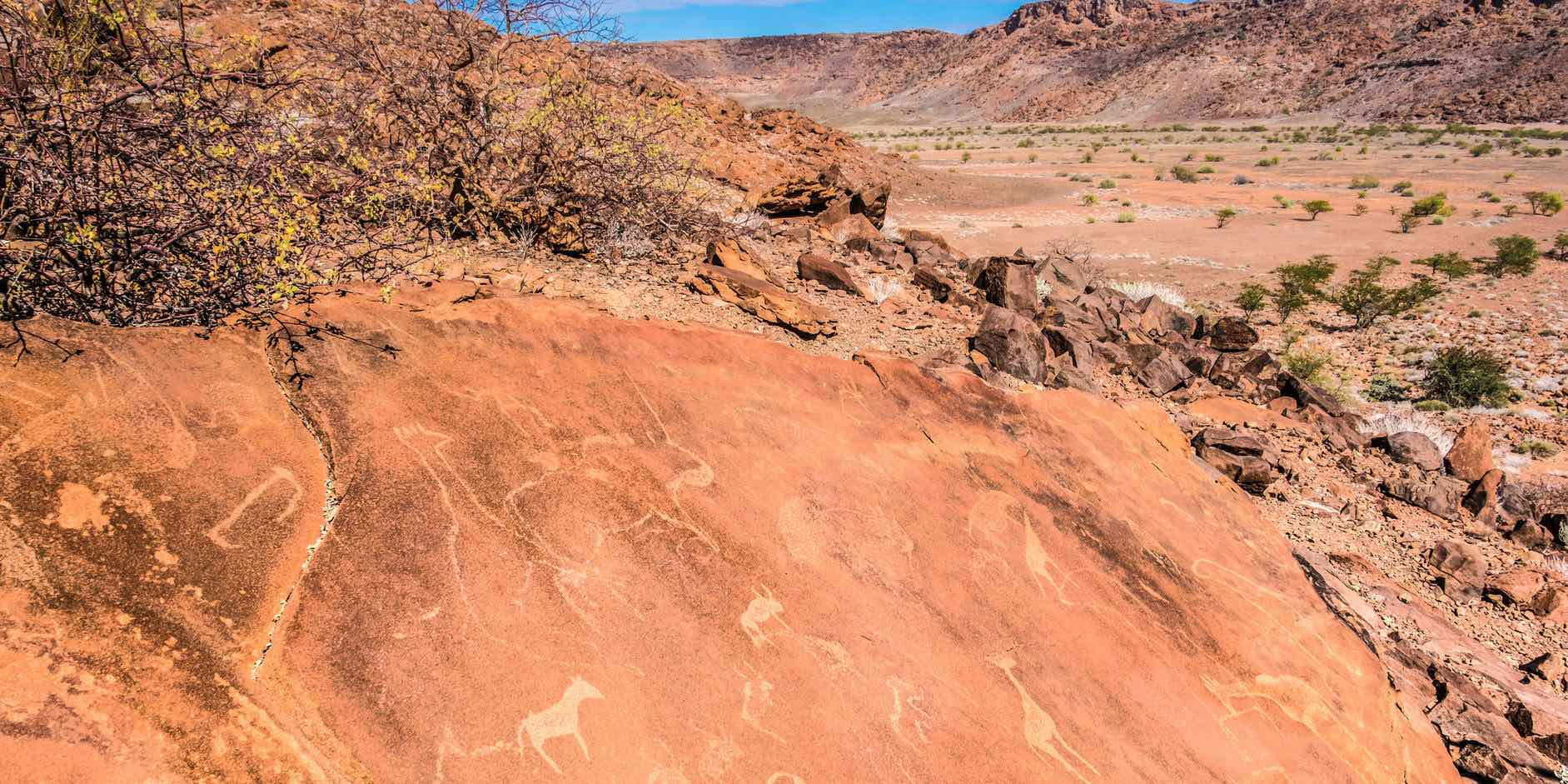
Heritage site fees are set annually by the National Heritage Council, and the last schedule we could verify ran from April 2024 to April 2025 at N$270 per adult for Twyfelfontein. Two fee cycles have passed since without a published update, and sources now disagree wildly on the Petrified Forest — one gives N$270, another about N$80. Budget generously and pay at the gate.
The coast
Swakopmund and Walvis Bay make the obvious base, and the B2 in is tar. The C34 salt road north to Henties Bay is 2WD-passable in the dry season. Cape Cross Seal Reserve is about 120 kilometres north of Swakopmund on that road, a 60 square kilometre reserve proclaimed in 1968, with up to 210,000 seals present in the November and December breeding season. Published opening hours vary by source — 10:00 to 17:00 is the common ground; an earlier summer opening appears in only one place.
Welwitschia Drive and the Moon Landscape need a permit bought in advance from MEFT, not at a gate. The offices are in Swakopmund at the corner of Bismarck Street and Sam Nujoma Avenue, in Windhoek at the Troskie Building on Uhland Street, and at Sesriem for Namib-Naukluft only. The loop runs roughly 160 kilometres round trip from Swakopmund on the C28 and D1991, and a 2WD with good clearance handles it.
The south
The Fish River Canyon viewpoint sits at the end of well-graded gravel and needs no 4×4 in the dry season. The canyon hike is a different proposition — MEFT requires booking and a fitness test for it. The Quiver Tree Forest outside Keetmanshoop is on the private farm Gariganus, fourteen kilometres northeast of town off the B1, 2WD, with fees paid at farm reception.
Kolmanskop runs guided tours Monday to Saturday at 09:30 and 11:00, and at 10:00 on Sundays and public holidays. Adult entry is N$180 and a child aged six to fourteen is N$70. The photography permit is N$400 per person, valid sunrise to sunset, and comes with a gate access code. Night photography is not permitted, because the site sits inside a restricted diamond area. Tickets are sold online, at the entrance gate, or at Desert Deli in Lüderitz.
Two stops that are not what the guidebooks say
You cannot drive yourself onto the Waterberg Plateau. MEFT lists guided drives on the plateau as the tourism activity, and NWR sells only guided morning and afternoon drives. Self-drive access to the plateau top is not offered. The 48-kilometre unguided hiking trail is a different matter and requires booking.
Duwisib Castle has been closed since 2022 and was still closed as of July 2026, with no reopening date announced. NWR’s own website still carries a resort page for it with contact numbers, room counts and no closure notice. Do not build a driving day around it.
Fees and fuel: the two things that catch people out
Those rates took effect on 1 April 2026 for the Category 1 parks — Etosha, Waterberg, Namib-Naukluft, /Ai-/Ais, Tsau ǁKhaeb, Dorob, Cape Cross and Skeleton Coast. The Zambezi-region parks, Daan Viljoen, Hardap and Naute sit at N$200. Fees are valid for a 24-hour period from the time of entry, per person, per park. MEFT’s own downloadable fee schedule still shows the January 2021 numbers, which is worth knowing if someone quotes it at you.
Fuel is the sharper risk. NWR issued an advisory naming Halali, Okaukuejo, Sesriem Campsite and /Ai-/Ais as having no on-site fuel, and named its own alternatives: Outjo or Tsumeb for Etosha, Solitaire or Maltahöhe for Sesriem, Keetmanshoop or Karasburg for /Ai-/Ais. Reporting through 2026 suggests the problem has not gone away, with Solitaire in particular described as unreliable. Treat in-park fuel as a bonus, never as a plan. Our guide to what Namibian roads are actually like covers the driving itself, and staying healthy on a Namibia safari covers the rest of the self-sufficiency question. If you would rather not assemble the route yourself, the 17-day classic Namibia discovery safari links most of these stops in a sensible order.
Frequently asked questions
Can I still self-drive to Sossusvlei and Deadvlei?
Yes. MEFT issued a public notice on 2 May 2026 restoring self-drive access beyond the 2×4 parking area for visitors in 4×4 vehicles, alongside registered tour guides and the concession shuttle. Buses and trucks remain prohibited. A brief restriction imposed on 1 May 2026 was reversed the following day.
What are Namibia’s national park entrance fees now?
From 1 April 2026, the Category 1 parks charge N$280 per day for a foreign adult, N$180 for SADC nationals and N$60 for Namibians, plus N$60 for a vehicle seating up to ten. Note that MEFT’s own published fee PDF still shows the 2021 schedule.
Do I need a 4×4 for a Namibia self-drive safari?
Not for most of the classic circuit. Etosha’s main roads, the Fish River Canyon viewpoint, Spitzkoppe, the Quiver Tree Forest and the C34 coast road are all manageable in a 2WD with decent clearance in the dry season. You need a 4×4 for the last five kilometres to Sossusvlei, and for anything in Kaokoland.
Is Duwisib Castle open?
No. It has been closed since 2022 and remained closed as of July 2026, with no reopening date. Namibia Wildlife Resorts still carries a live-looking page for it on its website, which has caught out a lot of travellers.
Where should I refuel on a Namibia self-drive?
Outside the parks. NWR has repeatedly advised that on-site fuel at Etosha, Sesriem and /Ai-/Ais has been unavailable, and named the alternatives itself: Outjo or Tsumeb before Etosha, Solitaire or Maltahöhe before Sesriem, Keetmanshoop or Karasburg before /Ai-/Ais.
Access rules in Namibia changed three times in eighteen months at Sossusvlei alone. Ask us to confirm the current position before you finalise a route — we check it, not a blog post from 2023. Tell us what you want out of the trip rather than when you can travel, and we will tell you honestly whether your dates fit — including when the answer is that they do not. Get in touch with Desert Tracks.