Namibia Off the Beaten Track: Where the Rules Actually Change
Off the beaten track in Namibia is not a mood, it is a documented set of requirements. **Khaudum is the only park that legally requires a convoy** of two or more vehicles. Van Zyl’s Pass, despite its reputation, requires no convoy at all — but it has a direction rule everyone follows. Skeleton Coast Park turns on gate times, not gearing. Sandwich Harbour and Welwitschia Drive turn on a permit bought in an office., the dry winter. Rainfall is near zero, wildlife concentrates at Etosha’s waterholes, and roads are at their best. July and August are the peak — and the coldest, near 6 °C at dawn.
These are places where getting it wrong is expensive and occasionally dangerous, so this article sticks to what the ministry, the mapping publishers and the conservancies actually state. Where sources disagree, we say so instead of picking the confident-sounding one.
The requirements, in one place
Khaudum: the one place the convoy rule is real
MEFT states it plainly: Khaudum requires visitors to be in a convoy of two or more vehicles, and only one vehicle of the convoy may tow a trailer. That trailer clause is almost never reported and it has caught people out. The ministry also specifies at least three days of food rations per person and 100 litres of water per vehicle.
The park covers 3,842 square kilometres of Kalahari sandveld with omurambas — fossil river courses — running through it, proclaimed in 1989. There are twelve artificial waterholes, two natural fountains and several game-viewing hides, and few tracks through deep sand. Fewer than three thousand people visit in a year. Entry sits in the lower fee band at N$200 per day for a foreign adult since April 2026.
MEFT’s own Khaudum park page softens the requirement to “at least two 4×4 vehicles are recommended per party”. The permit FAQ makes it mandatory. Plan on the mandatory wording, because that is what the gate will apply.
Van Zyl’s Pass: the rule everyone quotes is the wrong one
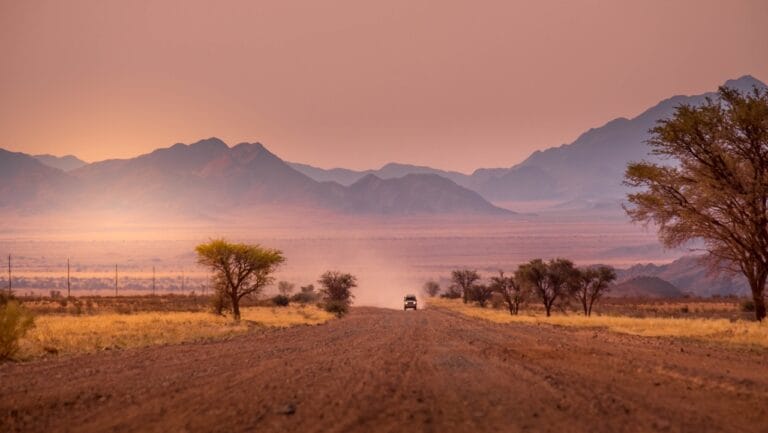
You will read constantly that a convoy is required on Van Zyl’s Pass. We could not find a regulation anywhere that says so. The pass sits outside the national park system on communal conservancy land, so no MEFT gate rule reaches it, and MEFT’s own list of parks with special vehicle requirements names only Khaudum. Travelling in company is sound advice, and there is no recovery service out there, but it is advice.
The rule that is close to absolute is direction. Tracks4Africa is explicit that you do not drive the pass west to east, bottom to top, because it is too dangerous — you only descend it east to west. It calls the pass the toughest in Namibia, ten to fifteen kilometres of hard driving through boulders, rocks, ravines and badlands, passable only in a 4WD or an off-road motorbike no larger than 650cc. Driver ability, not vehicle badge, is the deciding factor. And you exit the region to the south, via Orupembe.
Kaokoland: the self-sufficiency is the requirement
North of Orupembe there is no water anywhere except the northern campsites, and no shops, fuel or other supply points at all. Rough terrain burns considerably more fuel than a road map suggests. Marienfluss and Hartmann’s Valley need a 4×4 with low range, not a soft-roader in four-wheel drive. Marienfluss is a wildlife conservancy and wild camping is not permitted there.
That last point is worth sitting with. These are not empty places. Kaokoland is Himba country, held and managed under conservancies, and the campsites, the fees and the restrictions exist because people live there and have organised how visitors move through. Arriving with a satellite phone and no plan for where you will legally sleep is the most common failure we see.
Skeleton Coast Park: it is a clock, not a gearbox
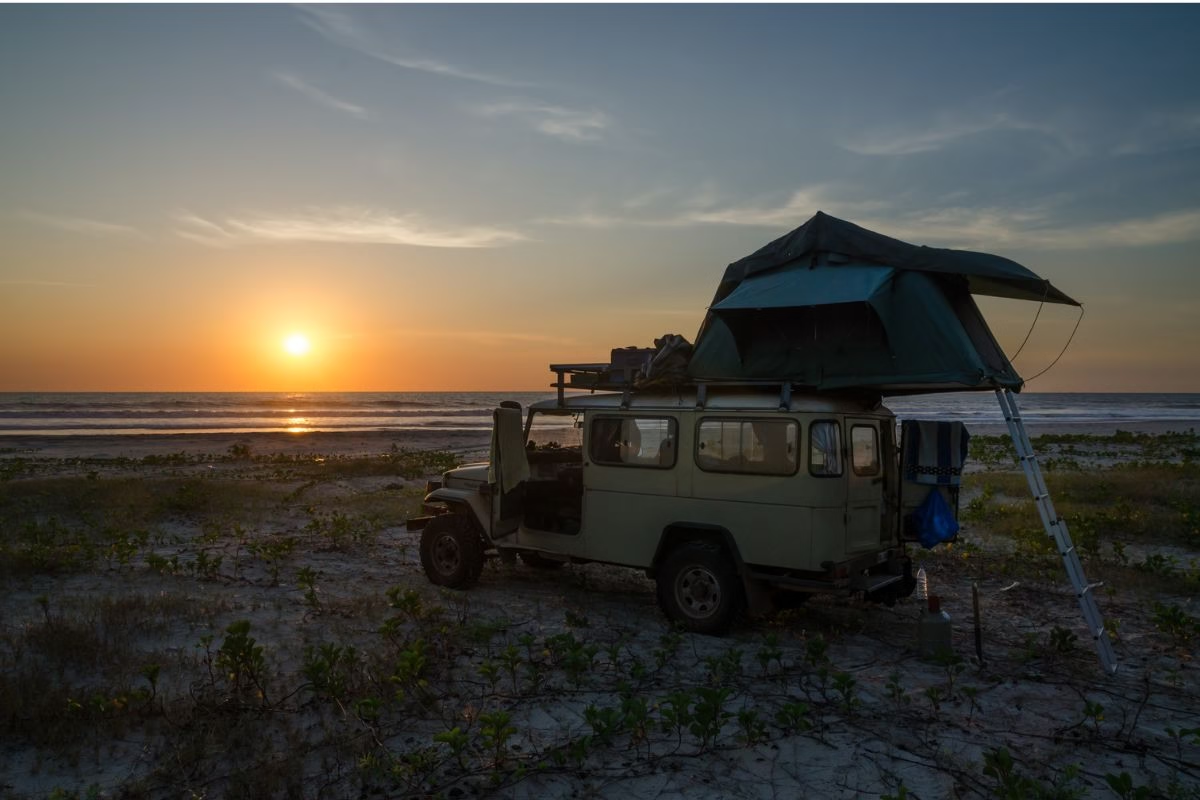
This one surprises people. The transit route through Skeleton Coast Park does not require a 4×4 — the road is rough but passable in a normal vehicle. What it requires is arriving on time. Transit permits are issued at the Ugab Gate on the C34 or the Springbokwasser Gate on the C39, and they permit travel between the gates only. Ugab entry closes at 15:00 and if you reach the gate after that you are turned away; exit runs to 19:00. Sources disagree on Springbokwasser, one giving 15:00 and another 17:00, so plan on 15:00.
You must clear the park the same day unless you can show proof of accommodation inside, and rangers check that every vehicle which entered has either left or reached its camp by day’s end. MEFT states entrance is only with a booking and that a fishing licence must be obtained before entering. The park runs 500 kilometres from the Ugab River north to the Kunene and about forty kilometres inland, 16,390 square kilometres in all. Everything north of Terrace Bay is fly-in concession, closed to vehicles entirely.
The permit places
Sandwich Harbour and Welwitschia Drive both require a permit obtained in advance from MEFT’s Directorate of Regional Services and Parks Management — not at a gate, and not online. The offices are in Swakopmund at the corner of Bismarck Street and Sam Nujoma Avenue, in Windhoek at the Troskie Building on Uhland Street, and at Sesriem for Namib-Naukluft only. That single office visit is what separates these from the stops in our hidden gems article, where nothing needs paperwork in advance.
MEFT tendered a management and shuttle-guiding concession for Sandwich Harbour in 2024, explicitly to limit tourism impact on the Ramsar site. We could not establish the outcome. Given what happened at Sossusvlei under an identical concession model, treat self-drive access there as unconfirmed and check with MEFT Swakopmund before you commit to it.
Messum Crater and the Naukluft trail
Messum Crater is 4×4 only, on unpaved sandy and rocky track with sharp protruding rocks that will take a tyre. Keep to 40 km/h, stick to existing tracks, carry recovery gear and a GPS. Nearest fuel is Palmwag or Henties Bay. A second vehicle is recommended, and we want to be precise about that word: recommended, not required. It is not Khaudum.
The Naukluft 4×4 Trail runs about 73 kilometres with an overnight at Tjeriktik camp, capped at sixteen people and four vehicles, with only one group on the plateau at a time. Reservations through the Windhoek office are essential, check-in is by midday with a briefing before a 14:30 departure, and the trail can close in wet weather. We could not confirm that it is currently open and taking bookings, or its fee — phone NWR before you build a trip around it.
Before you commit
None of this is meant to talk you out of it. The far north-west is the best driving in southern Africa and the parts of Namibia that require the most also give the most back. But the gap between a graded gravel road and Van Zyl’s Pass is enormous, and hire agreements often exclude exactly these routes. Read our guide to what Namibian roads are actually like first, and if this is a first Namibian trip, the main self-drive circuit is not a lesser experience — it is a different one, and it is the right one to start with.
Frequently asked questions
Which Namibian park requires a convoy?
Khaudum, and only Khaudum. MEFT states that visitors must be in a convoy of two or more vehicles, and that only one vehicle in the convoy may tow a trailer. No other Namibian park carries a convoy requirement.
Is a convoy required on Van Zyl’s Pass?
No. There is no regulation requiring it. Van Zyl’s Pass sits outside the national park system on communal conservancy land, so no MEFT gate rule applies. Travelling in company is strong advice, not law. What is close to an absolute rule is the direction: descend east to west, never climb it the other way.
What do I need to carry for Khaudum?
MEFT specifies at least three days’ worth of food rations per person and 100 litres of water per vehicle, in addition to the two-vehicle convoy. The park has few tracks through deep Kalahari sand.
Do I need a permit for the Skeleton Coast Park?
Yes. A free transit permit is issued at the Ugab Gate on the C34 or the Springbokwasser Gate on the C39, and it only allows travel between the gates. Staying overnight requires proof of a booking. The gate cut-off times matter more than the vehicle — arrive late and you are turned away.
Can I self-drive to Sandwich Harbour?
A MEFT permit obtained in advance is required, from the offices in Swakopmund, Windhoek or Sesriem. MEFT tendered a management and shuttle-guiding concession for Sandwich Harbour in 2024 and we could not establish the outcome, so confirm the current arrangement with MEFT Swakopmund before you travel.
We run these routes, and we will also tell you honestly when a group is not ready for one. Ask us either way — the answer costs you nothing and the alternative can cost a great deal. Tell us what you want out of the trip rather than when you can travel, and we will tell you honestly whether your dates fit — including when the answer is that they do not. Get in touch with Desert Tracks.