Namibia’s German Heritage: Exploring Swakopmund
Swakopmund was founded on 4 August 1892 by Curt von François as Germany’s own landing place, because Walvis Bay was British. Its German buildings survive as proclaimed national monuments, alongside the site of a concentration camp the architecture does not mention., the dry winter. Rainfall is near zero, wildlife concentrates at Etosha’s waterholes, and roads are at their best. July and August are the peak — and the coldest, near 6 °C at dawn.
Swakopmund is the most photographed German colonial town in Africa, and the photographs almost never include the part of its history that matters most. The pastel facades, the Bavarian gables and the palm-lined streets are genuinely remarkable. So is what happened here between 1905 and 1907, and a visit that takes in one without the other has missed the town.
Why a town was built here at all
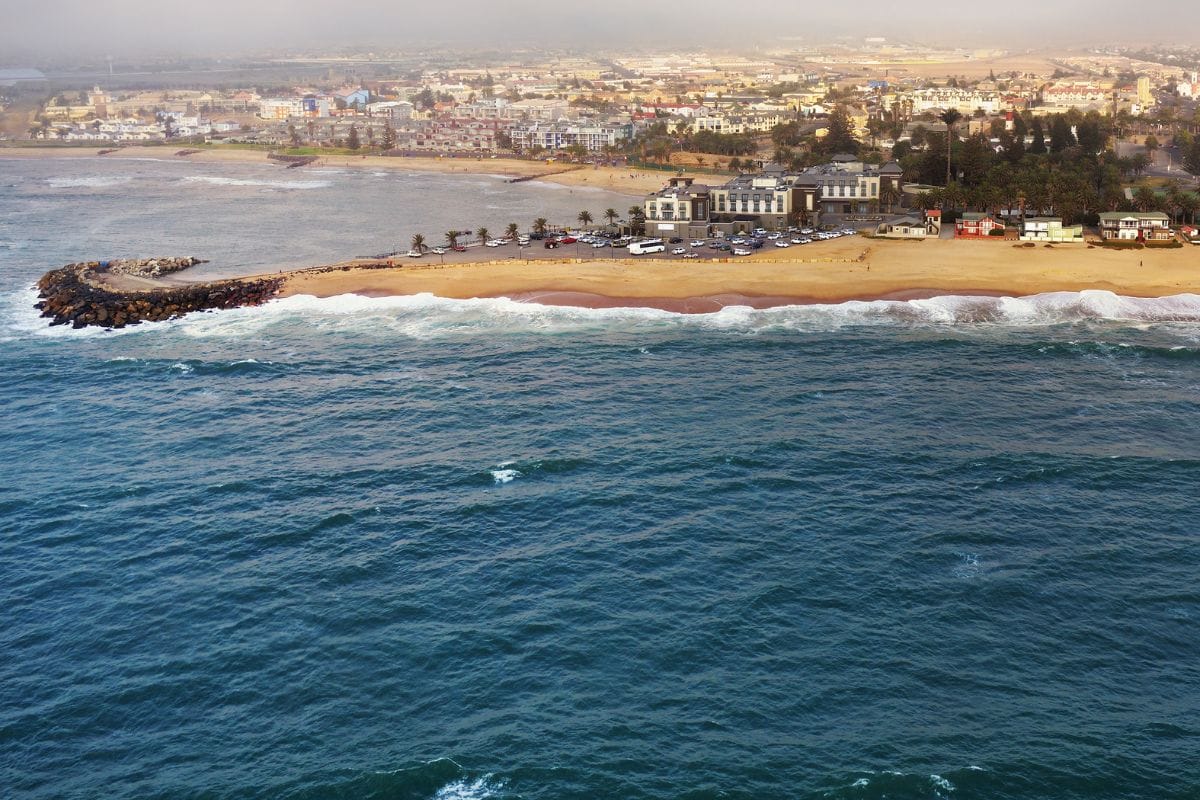
Curt von François founded Swakopmund on 4 August 1892 for a straightforward reason: the only natural deep-water harbour on this coast was Walvis Bay, and Walvis Bay was British. Germany needed somewhere to land people and cargo in its own territory, and picked a stretch of open surf beside the mouth of the Swakop River.
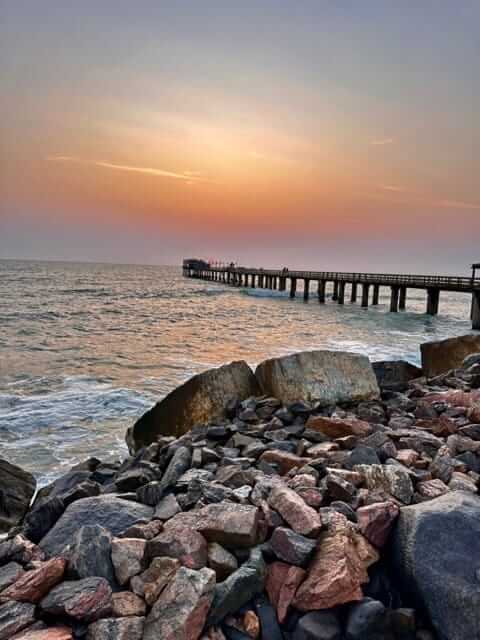
It never really worked. The Mole breakwater was begun on 2 September 1899 and completed in February 1903; it silted up within a year. A wooden jetty went up in 1904, ran 280 metres out to sea, and was eaten by woodworm by April 1905. An iron jetty was started in 1912, reached 260 metres of a planned 640, and stopped when war broke out in August 1914. It never carried a single cargo. All three are still there, and the town’s most photographed landmark is a pier that never did its job.
The buildings, dated and named
Swakopmund’s colonial architecture is unusually well documented, and much of it is formally protected. The National Heritage Council of Namibia, established under Act 27 of 2004, maintains the register of proclaimed heritage places.
The Old Prison is the one that unsettles people. It is an ornate, almost whimsical building, and it has been a working prison for well over a century. You can photograph the outside; that is all.
The camp, and what is known about it
Governor von Bülow ordered the establishment of concentration camps on 9 December 1904. The camps at Swakopmund and Lüderitz were built in 1905, during the war against the OvaHerero and Nama. Across the system as a whole roughly 15,000 OvaHerero and 2,000 Nama were detained, and approximately 7,700 people died between October 1904 and March 1907 — a mortality rate of around 45 per cent. Figures specific to the Swakopmund camp alone are widely repeated online but could not be traced to a reliable source, so they are not given here.
The dead are buried at the African Cemetery. A memorial tombstone was inaugurated there in 2007 and replaced in 2020 with one that names the responsibility of the German army. Remains taken to Germany for racial research have been returned in stages: twenty skulls repatriated from the Charité in Berlin in 2011, a further repatriation in 2014, and nineteen skulls together with a scalp in August 2018.
The Swakopmund Museum, founded in 1951 and the largest privately run museum in Namibia, does not cover the genocide. It opens daily from 10:00 to 17:00 and adult entry is N$45. The Swakopmund Genocide Museum in Mondesa does — founded in 2015 by Laidlaw Peringanda, officially recognised in 2019, and roughly twelve square metres in size. If you visit one, visit both.
A town still arguing with its own street signs
Kaiser-Wilhelm-Straße became Sam Nujoma Avenue in 2001. Some residents responded by repainting the old names. That small act is the clearest available summary of where the town sits with its history: not resolved, not hidden, still being negotiated in public.
The German language is not a museum piece here either. It is a recognised national language, 32 schools teach it to around 14,000 pupils, and the Allgemeine Zeitung is the only German-language daily newspaper on the African continent. Swakopmund constituency recorded a population of 75,921 in the 2023 census.
Two nights is enough to walk the town properly, see both museums and take in the cemetery. One night turns it into a photo stop, which is the version most itineraries sell.
Swakopmund sits naturally on a longer loop — a nineteen-day deserts-and-falls route typically gives it two nights between the Namib and the north. If you want the wider coastal context, the history of Walvis Bay explains why the British held the harbour and the Germans had to build here. And the town’s name itself has a more interesting story than the guidebooks tell — we looked into what Swakopmund actually means.
Frequently asked questions
When was Swakopmund founded?
4 August 1892, by Curt von François. Germany needed its own landing place on the coast because Walvis Bay, the only natural deep-water harbour, was British.
Which Swakopmund buildings are proclaimed national monuments?
The railway station of 1901, proclaimed 27 October 1972 and now a hotel; the Woermannhaus of 1905 by Friedrich Höft, proclaimed 10 December 1971 and now the public library; and the Old Prison of 1907–09 by Otto Ertl, proclaimed 1973 and still a prison.
Why does Swakopmund have three jetties?
Because the first two failed. The Mole breakwater, begun 2 September 1899 and finished February 1903, silted up within a year. A 280-metre wooden jetty built in 1904 was destroyed by woodworm by April 1905. The iron jetty begun in 1912 stopped at 260 metres of a planned 640 when war broke out in August 1914, and never carried cargo.
Was there a concentration camp at Swakopmund?
Yes. Governor von Bülow ordered the camps on 9 December 1904 and the Swakopmund and Lüderitz camps were built in 1905. Across the whole camp system roughly 15,000 OvaHerero and 2,000 Nama were detained, and about 7,700 people died between October 1904 and March 1907 — a mortality rate of roughly 45 per cent.
Is German still spoken in Namibia?
Yes. German is a recognised national language, 32 schools teach it to around 14,000 pupils, and the Allgemeine Zeitung is the only German-language daily newspaper in Africa.
Where can I learn about the genocide in Swakopmund?
The Swakopmund Museum, founded in 1951, does not cover it. The Swakopmund Genocide Museum in Mondesa, founded in 2015 by Laidlaw Peringanda and officially recognised in 2019, does. It occupies about twelve square metres.
Desert Tracks builds Namibian journeys that give the coast the time it deserves. Tell us what you want to understand and we will build the route around it. Tell us what you want out of the trip rather than when you can travel, and we will tell you honestly whether your dates fit — including when the answer is that they do not. Get in touch with Desert Tracks.