The History of Walvis Bay – The Port That Stayed South African Until 1994
Walvis Bay became Namibian on 1 March 1994, four years after the rest of the country. Britain annexed it on 12 March 1878; the Cape Colony absorbed it in 1884, the same year Germany claimed the surrounding territory. It has been an anomaly ever since., the dry winter. Rainfall is near zero, wildlife concentrates at Etosha’s waterholes, and roads are at their best. July and August are the peak — and the coldest, near 6 °C at dawn.
Namibia became independent on 21 March 1990. Its only deep-water port did not. For four more years Walvis Bay remained South African territory, an enclave of 1,124 square kilometres entirely surrounded by a country it did not belong to — and the reason goes back to a single year, 1884, when two European powers claimed the same coastline from different directions. It is the strangest thing about Namibian geography and most visitors drive through it without knowing.
The dates that matter
How a British enclave ended up inside a German colony
The bay had been known to Europeans for four centuries before anyone claimed it. Diogo Cão was probably the first European ashore on this coast in 1485; Dias anchored in the bay itself on 8 December 1487, the feast of the Conception, and named it accordingly. Portuguese mariners later called it the Bay of Whales for the obvious reason, and that name stuck through Dutch and British hands into Afrikaans and English.
The formal claims are unusually well documented, because they ended up in front of an international arbitrator. The 1911 award in the Walfish Bay boundary case between Germany and Great Britain recites the sequence: Captain Dyer of the Industry proclaimed possession on 12 March 1878, Letters Patent ratified it on 14 December 1878, and the Cape Colony formally incorporated the territory on 7 August 1884. Germany established its protectorate over the surrounding coast in the same year. Britain had the harbour; Germany had everything around it.
Four years out of step
From 1922 the enclave was administered together with South West Africa, which made the anomaly invisible in practice. South Africa reversed that on 1 September 1977, transferring Walvis Bay back to the Cape Province and making it an exclave once more. The UN Security Council responded in July 1978 with Resolution 432, declaring that Namibia’s territorial integrity required the reintegration of Walvis Bay.
It took sixteen more years. Namibia became independent in March 1990 without its port. A Joint Administrative Authority was set up in November 1992 to run the territory during negotiations, and the treaty was signed on 28 February 1994. Walvis Bay and the offshore Penguin Islands became Namibian at midnight that night — 1 March 1994. Sources differ on whether twelve or thirteen offshore islands were included, which is a fitting last detail for a place this complicated.
Why the port matters now
Walvis Bay is Namibia’s only deep-water port capable of handling large ships, and the numbers have moved sharply. In the financial year to March 2025 the port handled 6,336,065 tonnes of general cargo, up 13%, and 253,996 containers, up 48% — the container jump following a new terminal concession that began in November 2024. It received 1,850 vessel calls.
The infrastructure behind that: a new container terminal built on 40 hectares reclaimed from dredged material, 600 metres of quay, four post-panamax cranes, taking capacity from 350,000 to 750,000 containers a year. The entrance channel has been deepened to 16.5 metres below chart datum, which is what allows the largest container vessels afloat to come in. The port is also the sea end of four trade corridors reaching into Botswana, Zambia, the DRC, Angola and South Africa.
The lagoon, the salt and the birds
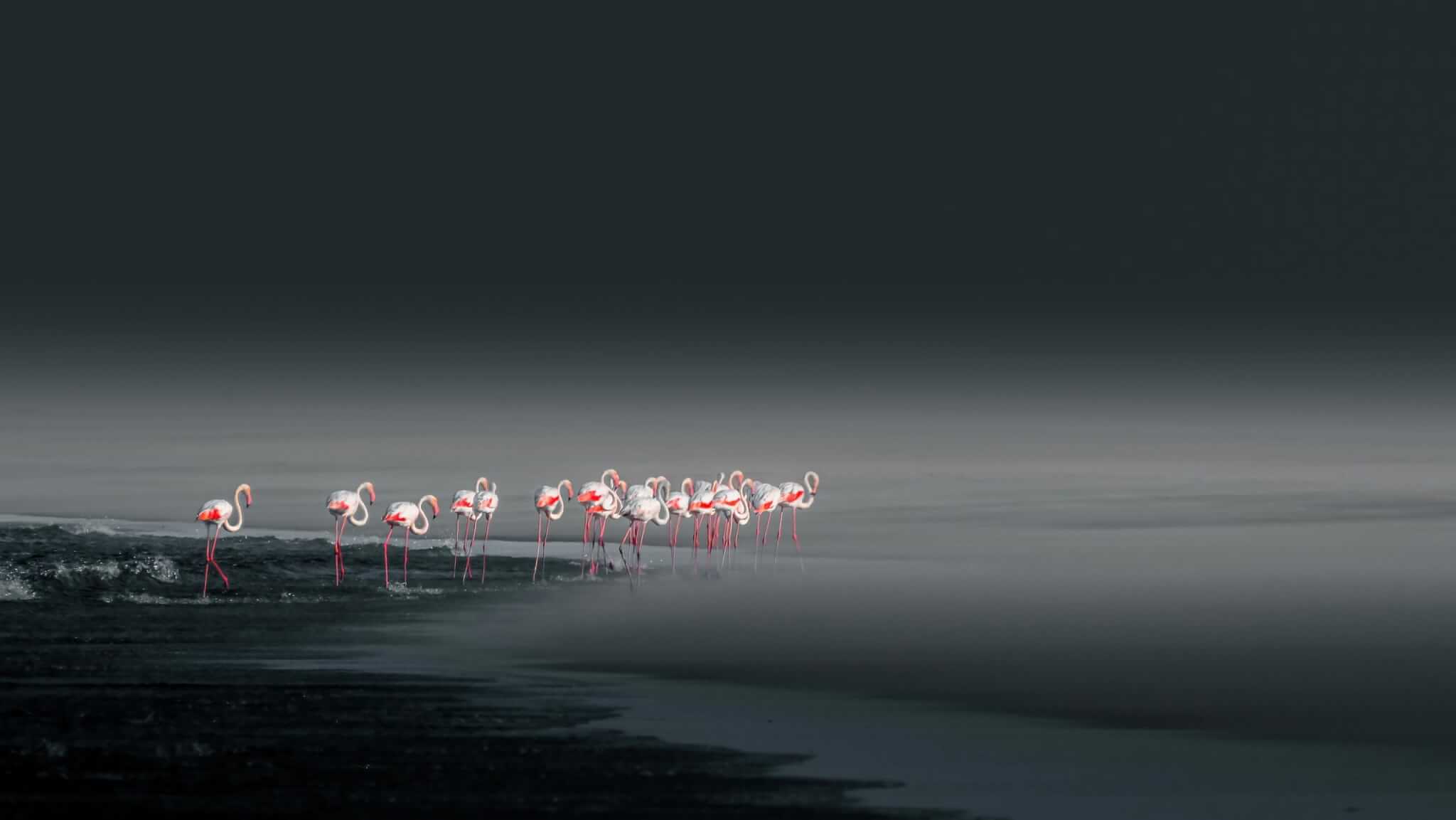
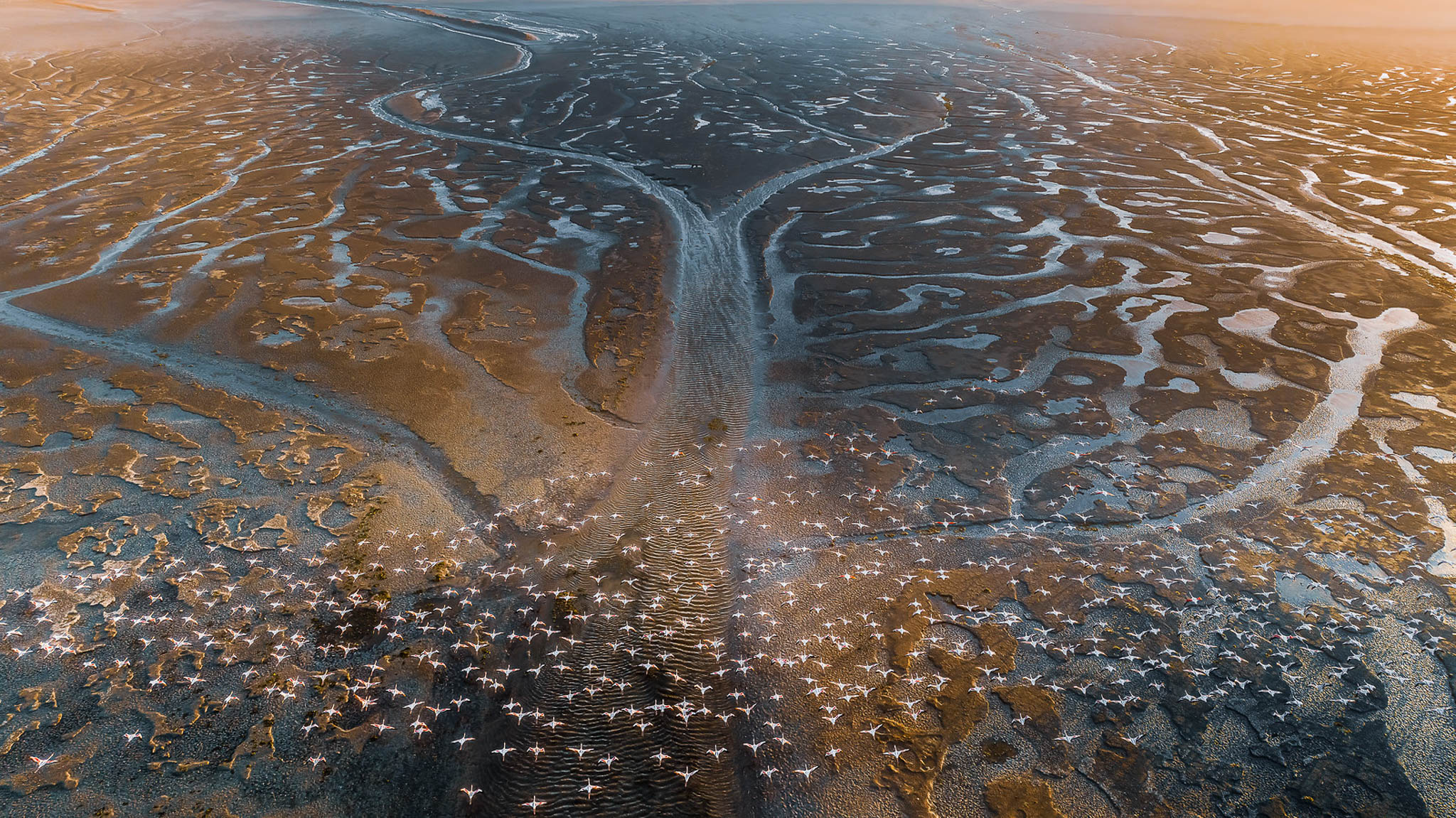
Walvis Bay is Ramsar site no. 742, designated on 23 August 1995 and covering 12,600 hectares. The official listing records between 37,000 and 79,000 wetland birds and eleven regularly-occurring endangered species. Independent counts have gone considerably higher — a median of 156,000 waterbirds across summer surveys, and 242,000 birds counted in one summer in 2004. For 25 species the maximum counts exceeded regional population thresholds. The wetland seasonally holds around 60% of the world population of chestnut-banded plover.
The salt works are inside the Ramsar site and have operated since 1964, processing 100 million cubic metres of seawater a year into roughly a million tonnes of salt at 99.4% purity. The guano platform off the bay dates to 1930, part of a Namibian guano industry that ran from the late 1800s into the 1990s.
You will read confident flamingo counts for Walvis Bay in a lot of places. We could not find an authoritative figure for either species — Ramsar itself says only that flamingos occur in impressive numbers — so we have quoted the total waterbird counts instead, which are real. If you see a precise flamingo number elsewhere, ask where it came from.
The whales it was named for
The Bay of Whales earned its name and then lost the whales. Open-boat whaling on the Walvis Bay ground intensified between 1788 and 1803, peaking at 28 identified whaling vessels in 1796; across those fifteen years researchers have identified 76 American, 39 French and 71 British whaling vessels working here. Right whales off Namibia were severely depleted by early nineteenth-century whaling and have never fully returned.
What you can see today is different and still worth the boat trip — whale watching on the Namibian coast covers what turns up and when. For the German colonial architecture just up the road, Swakopmund’s German heritage is the companion piece. And if you are driving the coast yourself, our self-drive routes usually run Swakopmund and Walvis Bay as a pair.
Frequently asked questions
When did Walvis Bay become part of Namibia?
On 1 March 1994, four years after the rest of Namibia became independent. The treaty was signed on 28 February 1994 and the handover took place at midnight that night. Until then Walvis Bay was South African territory surrounded by an independent Namibia.
Why was Walvis Bay not part of Namibia at independence?
Because it was never part of German South West Africa. Britain annexed the bay on 12 March 1878 and the Cape Colony incorporated it on 7 August 1884 — the same year Germany established its protectorate around it. It passed to South Africa with the Cape, and South Africa kept it when Namibia became independent in 1990.
Why is Walvis Bay important to Namibia?
It is the country’s only deep-water port able to handle large ships. In the 2024/25 financial year it moved 6,336,065 tonnes of general cargo and 253,996 containers, and its entrance channel has been dredged to 16.5 metres so it can take the largest container vessels afloat.
Desert Tracks arranges self-drive and fly-in itineraries across Namibia, Botswana and East Africa. We are based just up the coast in Swakopmund — ask us what is actually worth your time in Walvis Bay. Tell us what you want out of the trip rather than when you can travel, and we will tell you honestly whether your dates fit — including when the answer is that they do not. Get in touch with Desert Tracks.