Solo Self-Drive in Namibia, Including as a Woman
Travellers who have done it say solo self-drive in Namibia is entirely doable, including for women driving alone. Official advice places the main crime risk in towns, at fuel stops and around unattended vehicles, not on the open road. The bigger challenges of driving alone are practical: changing a heavy tyre, long gravel days and patchy phone signal.
Forum questions about driving Namibia alone come mostly from women, and most of the replies are practical rather than alarmed. They talk about tyres, distances and fatigue far more than crime. Official travel advice agrees on where the crime risk sits. Here is what the governments say, the practical problems of driving alone, how to stay reachable, and the habits that manage the risk.
Where the risk actually is
The US State Department rates Namibia Level 2, “Exercise increased caution” (advisory of 15 May 2026), and says: “Most crimes against foreigners are crimes of opportunity, like purse snatching, pickpocketing, and smash and grabs from unoccupied parked vehicles.” For context, the 2025 Global Peace Index ranks Namibia third in Africa and 50th worldwide (Ecofin Agency).
The risk is concentrated in towns and around parked cars. Australia’s Smartraveller says: “Violent crime against foreigners includes muggings and robberies. Windhoek, Swakopmund and Walvis Bay are hotspots.” The UK government warns that “Muggers often target tourists in Windhoek” and that “Theft from vehicles, particularly at service stations, is common.” Canada lists theft from “unattended vehicles at gas stations and ATMs”.
Two more warnings are worth knowing. Germany’s Foreign Office reports isolated cases where travellers were followed from the airport to their accommodation after collecting a hire car, made to stop by a distraction such as a claimed technical fault, and robbed. And the US notes that “Use of date rape drugs has been reported at night clubs and bars in Namibia—especially in Windhoek, Walvis Bay, and Swakopmund.”
The practical problems of driving alone
The forum threads on solo and women-only self-drives keep coming back to the same three things. The first is the tyre. Several posters advise learning to change a wheel before you go, and one points out that just lifting the vehicle with the jack takes practice. See gravel tyre pressure and spares for what to check before you set off.
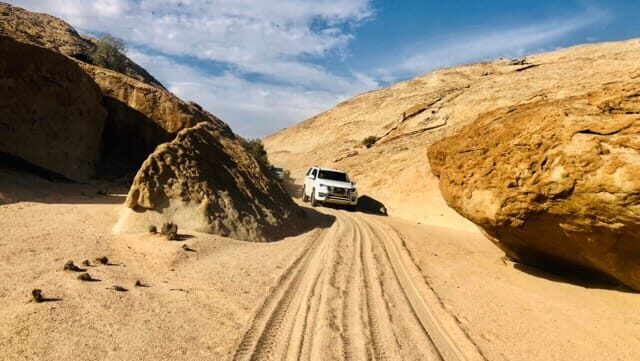
The second is distance and fatigue: replies to solo women raise long driving days more often than crime. Gravel makes those days slower. Canada advises “Do not exceed 80 km/h on gravel roads” and warns that many rural roads are gravel “with sloping sand shoulders”; the US says “Tourists are often involved in single vehicle roll-over accidents.” What Namibian roads are like covers speeds and surfaces.
The third is supplies. Forum regulars tell solo drivers to carry plenty of water, and some suggest a satellite phone for remote routes.
Staying reachable
Tourism Update Namibia says the cellular network reaches “up to 98% of the population”, and that “In bigger towns you will surf with 5G/4.5G/4G speed, especially in rural areas 3G is still the used standard.” That figure counts people, not roads, so expect gaps between towns. Our guide to eSIMs and mobile coverage in Namibia covers what works where.
Save the emergency numbers before you set off. The US State Department lists police on +264-61-10111 and ambulance on +264-61-10177; Germany’s Foreign Office gives 10111 for the police.
Habits that manage it
- Drive in daylight. The UK advises avoiding night driving outside towns, as wildlife and livestock are serious hazards.
- Keep car doors locked and windows shut. Smartraveller says “keep car windows up and doors locked, even when moving”.
- Don’t leave your vehicle unattended at fuel stops (UK advice).
- Don’t offer strangers lifts in your vehicle (Smartraveller).
- Don’t hail taxis from the street, particularly in Windhoek (UK advice).
- Watch your card when you pay: the UK reports “credit card skimming at some hotels and lodges”.
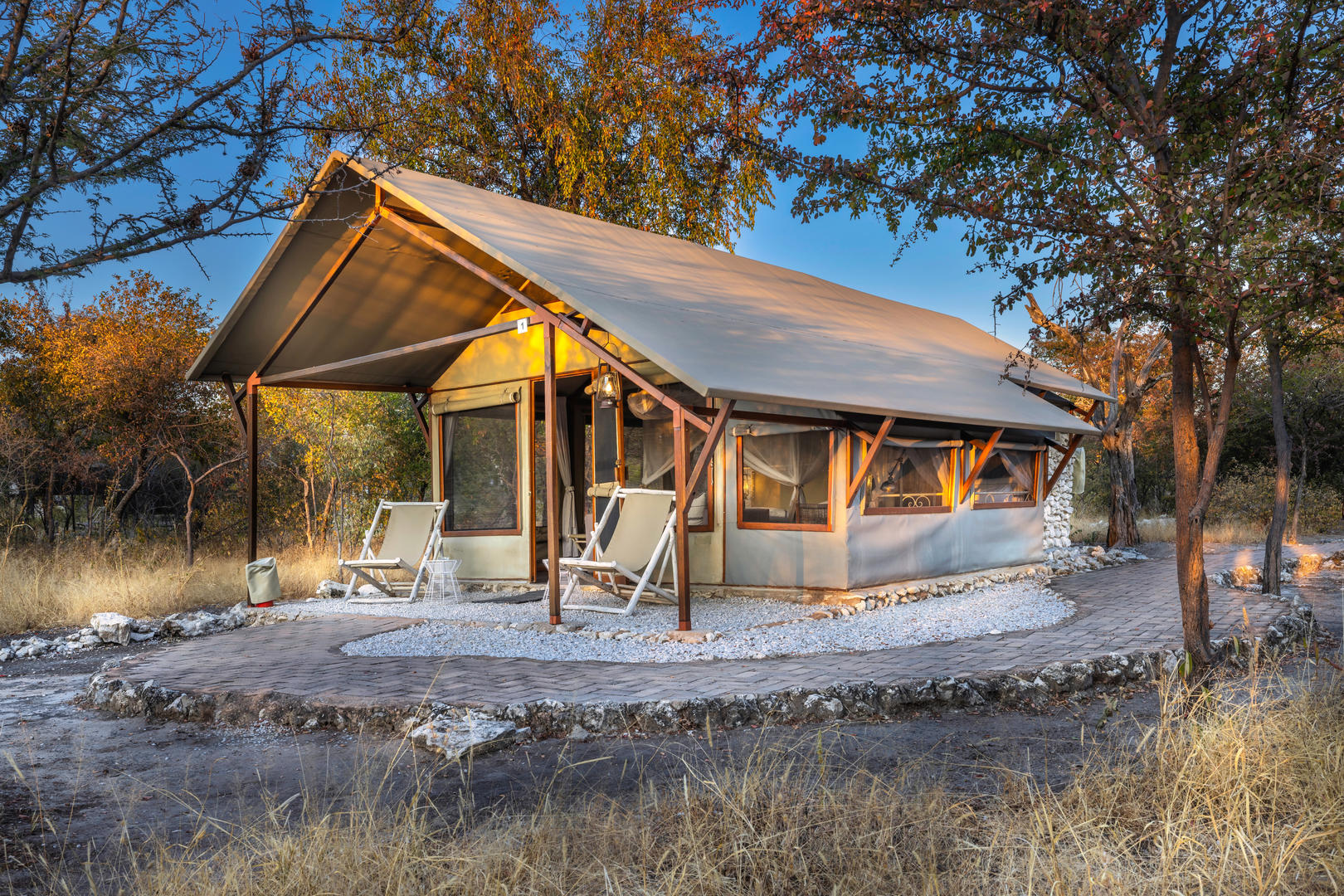
- Stay in guarded accommodation and on officially registered campsites, as Germany’s Foreign Office advises.
For the wider picture, read our essential Namibia self-drive safety tips.
Frequently asked questions
Is Namibia safe for a solo female self-drive?
Women who have done it say on the forums that it is entirely doable. Official advice places the main risks in towns, at fuel stops and around unattended cars, and the US rates Namibia Level 2, exercise increased caution.
What are the emergency numbers in Namibia?
The US State Department lists police on +264-61-10111 and ambulance on +264-61-10177. Germany’s Foreign Office gives 10111 for the police. Save them before you set off.
Will I have phone signal on the road in Namibia?
In towns, usually. Coverage is quoted as reaching up to 98% of the population, not of the road network, and rural areas often run on 3G. Expect gaps between towns.
Do I need to be able to change a tyre to self-drive alone?
Yes. Forum travellers’ first advice to solo drivers is to learn to change a tyre, and practise lifting the vehicle with the jack, before you set off on gravel.
Where is crime most likely in Namibia?
In towns and around parked cars. Australia’s Smartraveller names Windhoek, Swakopmund and Walvis Bay as hotspots for muggings and robberies, and the UK warns that theft from vehicles at service stations is common.
Should I give lifts to hitchhikers in Namibia?
No. Australia’s Smartraveller advises not to offer strangers lifts in your vehicle.
Desert Tracks plans self-drive Namibia safaris from our base in Swakopmund. Get in touch with Desert Tracks.