Cheetahs in Namibia: The Claim That No Longer Holds
Every Namibian safari company, this one included, has at some point told a client that Namibia holds the largest cheetah population in the world. It is the most repeated wildlife fact in the country. On the most recent figures it is no longer true.
Namibia holds roughly 1,498 adult cheetahs, about 21 per cent of the global population, against Botswana’s 24 per cent — so Namibia is no longer the largest national population. The species is listed as Vulnerable, and most Namibian cheetahs live on farmland rather than in parks., the dry winter. Rainfall is near zero, wildlife concentrates at Etosha’s waterholes, and roads are at their best. July and August are the peak — and the coldest, near 6 °C at dawn.
The claim, and where it stands now
The figures come from the CMS listing proposal published in October 2025, which cites Namibia at about 1,498 adult and adolescent cheetahs occupying some 60 per cent of the country — roughly 21 per cent of the world’s cheetahs — and puts Botswana’s share at 24 per cent. AfriCat’s own website still describes Namibia as holding the largest wild population in the world, with no figure and no year attached.
This is not a gotcha. Population estimates for a low-density, wide-ranging animal are genuinely hard, and the IUCN assessment says in its own text that the numbers are tentative and that comparisons with earlier estimates are unreliable. The honest position is that Namibia holds one of the two or three largest populations, that the ranking has moved, and that anyone quoting a confident number is choosing one study and not mentioning the others.
The speed figure is wrong too
Cheetahs are described everywhere as running at 70 mph. The only rigorous measurement of wild cheetahs hunting — published in Nature in 2013, using custom GPS and inertial collars across 367 runs by five wild animals — recorded a maximum of 25.9 metres per second. That is 58 mph, or 93 km/h.
The more interesting finding in that paper is that top speed barely mattered. Most hunts ran well below maximum, and success tracked lateral acceleration, deceleration and grip rather than outright pace. A cheetah hunt is won on cornering, not on the straight. One caveat worth stating: those measurements were taken in Botswana, not Namibia.
Why farmland is the whole story
Across the species, 77 per cent of known cheetah range and 67 per cent of the population sit on unprotected land. In southern Africa, only 18.4 per cent of confirmed range carries strict protection. In Namibia that means commercial and communal farmland, which is where the conflict lives: a predator that takes calves is a predator that gets shot, and no amount of tourism revenue reaches the farmer who lost the calf.
There is a counter-intuitive reason cheetahs do comparatively well outside parks. Cub mortality runs as high as 90 per cent in some regions, and it is concentrated where lion and hyena are common — which is to say, inside protected areas. Farmland has fewer big competitors. The animal that is easiest to kill is also, in places, safest there. Our pieces on Namibian leopards and the desert lions describe the same farmland-versus-park tension from the other side, and the conservancy system is the mechanism meant to resolve it.
What a visitor can actually expect to see
This is where most writing about Namibian cheetahs stops being useful, so plainly: a wild cheetah sighting is luck. They are thin on the ground, they range enormously, and they hunt in daylight in open country where you can see a long way and still see nothing.
The conservation centres are a different proposition, and worth understanding before you book one. The Cheetah Conservation Fund near Otjiwarongo says on its own day-visitor page that the animals you meet are its resident cheetahs, which cannot be released back into the wild. That is an encounter with named, captive animals in a research and education setting — a legitimate thing to do, and not a sighting.
At Okonjima, the reserve is re-wilded and the tracked animals are genuinely free-roaming, but the 2026 activity sheet the lodge publishes prices leopard, brown hyena, pangolin and rhino tracking — cheetah is not on it. The AfriCat Foundation itself cannot be visited independently; access runs through Okonjima’s guests. If a cheetah matters to your trip, ask what is actually on offer this season rather than assuming.

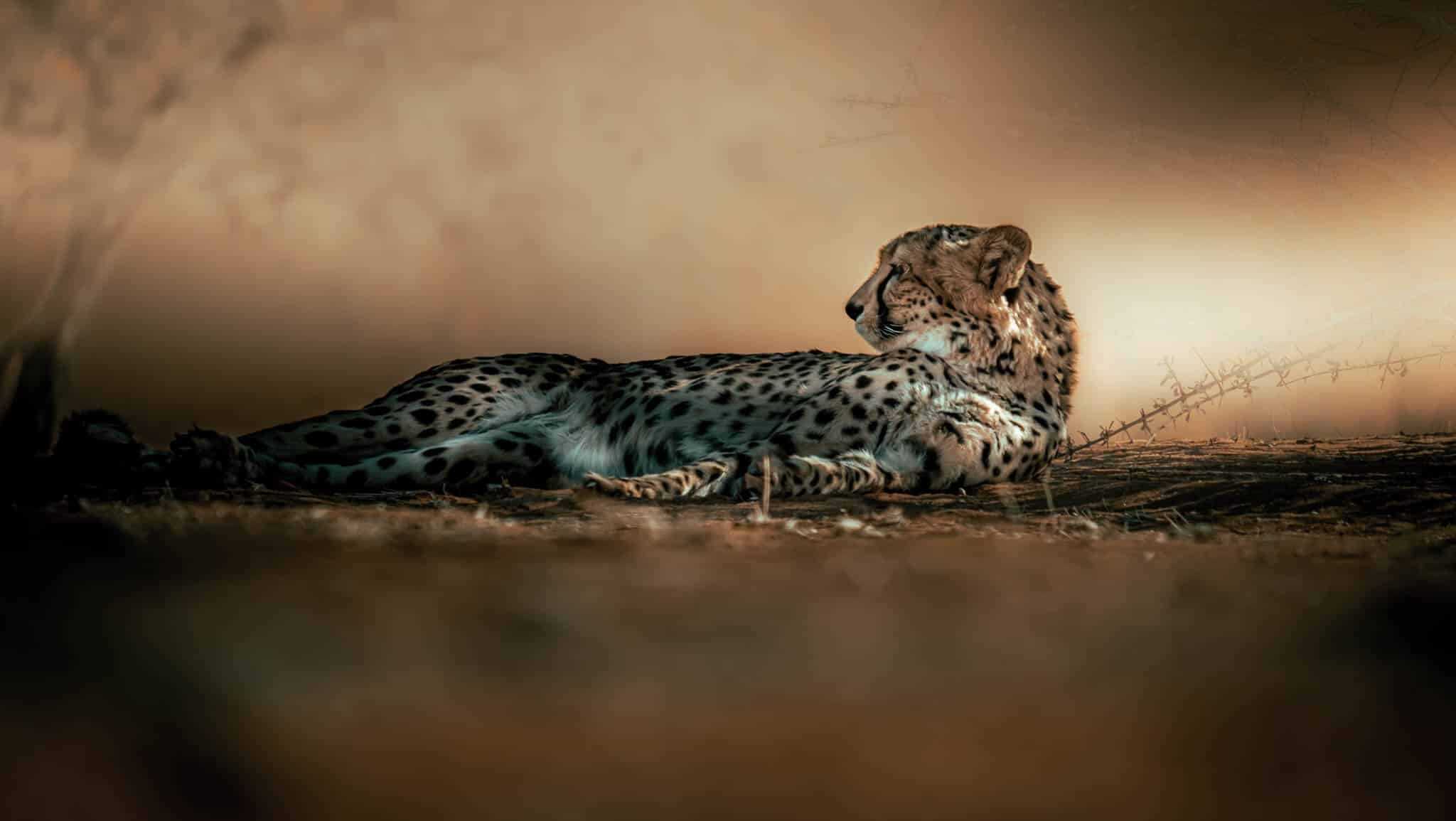
We have one photograph of a cheetah in our library and it is at the top of this page. The rest are the country these animals live in, captioned as such. Better to say so than to run a portrait from a game park somewhere else and let you assume.
Frequently asked questions
Does Namibia have the world’s largest cheetah population?
Not on the most recent credible figures. A 2025 CMS listing proposal puts Namibia at about 1,498 adults, roughly 21 per cent of the global population, against Botswana’s 24 per cent. The old claim is still repeated widely, including by Namibian conservation organisations.
How fast can a cheetah actually run?
The fastest measured run by a wild cheetah is 25.9 metres per second — about 58 mph or 93 km/h — recorded across 367 hunting runs on GPS and motion collars. The commonly quoted 70 mph has no measurement behind it.
Where do most Namibian cheetahs live?
On unprotected land. Across the species, 77 per cent of known range and 67 per cent of the population sit outside protected areas, and in southern Africa only 18.4 per cent of confirmed range is strictly protected. In practice that means farmland.
Can you see wild cheetahs in Namibia?
Sometimes, on open farmland and in the Kalahari, and never on demand. The conservation centres are a different thing: the Cheetah Conservation Fund’s animals are resident cheetahs that cannot be released, which is an encounter rather than a sighting.
Are cheetahs endangered?
The IUCN lists the species as Vulnerable, assessed in May 2021, with a decreasing trend and a global estimate of about 6,517 mature individuals. The assessment itself warns those estimates are tentative.
Desert Tracks books the Kalahari and the Okonjima reserve on guided and self-drive routes. Tell us what you want out of the trip rather than when you can travel, and we will tell you honestly whether your dates fit — including when the answer is that they do not. Get in touch with Desert Tracks.